
Your Brain Takes Out the Trash at Night. Here Is What Stops It.
What actually clears waste from your brain?
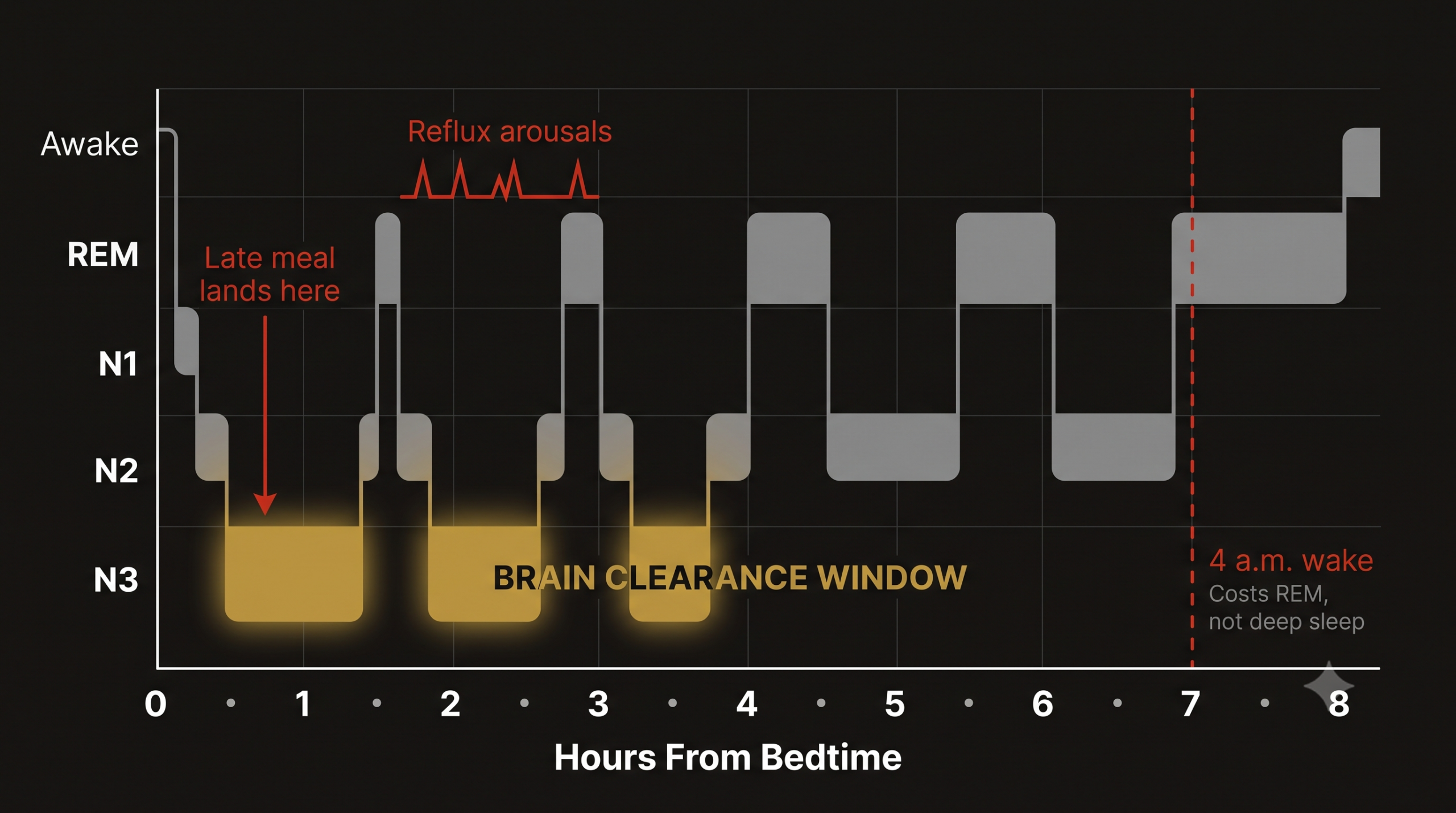
Your brain has a waste removal system called the glymphatic system, and it runs almost entirely during deep sleep. Cerebrospinal fluid washes through brain tissue and carries out metabolic garbage including amyloid beta and tau, the two proteins that define Alzheimer's pathology.
This is the "taking out the trash" idea you have heard discussed in the keto world. The mechanism is real. The trigger is not what most people think.
Why is sleep the trigger and not fasting?
Sleep is the principal driver of glymphatic flow, specifically the slow wave activity of stage N3 deep sleep. When Xie and colleagues published the founding work in Science in 2013, they found roughly a 60 percent increase in the brain's interstitial space during sleep in mice, along with faster clearance of beta amyloid.
The human confirmation arrived recently. A randomized crossover trial published in Nature Communications with 39 participants found that glymphatic clearance during normal sleep raised morning plasma levels of Alzheimer's biomarkers compared with sleep deprivation. The waste was leaving the brain and showing up in the blood. Deprive people of sleep and it stayed put.
Glymphatic flow is regulated by slow wave neural activity, cardiovascular and vasomotor pulsation, respiration, aquaporin-4 channel function, and body position. Fasting appears in narrative reviews alongside omega-3 intake and exercise as a possible contributor, but the evidence sits nowhere near what exists for sleep.
Here is the honest summary. If you want to clear brain waste, the lever is deep sleep. Everything else is secondary.
What Regulates Glymphatic Clearance
- 1Slow wave activity during NREM stage 3 sleep, the strongest and best-documented driver
- 2Cardiovascular and vasomotor pulsation, which is why arterial health matters
- 3Respiration and intrathoracic pressure
- 4Aquaporin-4 channel expression on astrocytes
- 5Body position and movement during sleep
- 6Physical exercise, which enhances clearance both directly and through improved sleep architecture
What does insulin resistance do to the brain?
Insulin resistance produces the same pattern of brain glucose hypometabolism seen in Alzheimer's disease, and it shows up in people who are still cognitively normal. This is the second half of the story and it runs on a separate track from waste clearance.
A systematic review of FDG-PET imaging studies found that 22 of 23 studies linked hyperglycemia or insulin resistance to reduced cerebral glucose metabolism. The affected regions were the parietotemporal cortex, posterior cingulate, and precuneus, which are the signature areas of Alzheimer's disease. The authors noted this held even in cognitively unimpaired individuals.
Researchers have taken to calling this "type 3 diabetes," describing Alzheimer's as an insulin resistant state of the brain. Whether or not that label sticks, the association is consistent across the literature: metabolic syndrome, obesity, and type 2 diabetes all raise dementia risk, with insulin resistance sitting at the center as the likely common thread.
So you have two failure modes, not one:
The brain cannot clear its waste, because deep sleep is fragmented or absent
The brain cannot fuel itself efficiently, because insulin signaling is impaired
Most people over 50 have some of both. Meal timing is one of the few levers that touches both at once.
How does meal timing fit into this?
Meal timing matters because of what it does to sleep quality and overnight glucose, not because of digestive enzyme cycles. Eating close to bedtime fragments sleep, drives nocturnal reflux, and keeps glucose and insulin elevated during the hours when they should be at their lowest.
That is the entire mechanism. It is simpler and better supported than any argument about morning stomach acid, and it is the version that holds up.
This is where the three scenarios come in. The same principle applies to everyone. How you apply it depends on the shape of your life.
Scenario 1: The Standard Schedule
Who is this?
You wake between 6 and 8 in the morning. You do not train before dawn. You are not on acid reflux medication. You have full control over when you eat.
What is threatening your brain clearance?
Late eating, most likely. If dinner ends at 8 or 9 in the evening and you are in bed by 10, you are asking your body to run digestion and deep sleep at the same time. Slow wave sleep is concentrated in the first half of the night, which is exactly the window that a late meal degrades.
Second threat: an eating window that runs 14 or 15 hours a day keeps insulin elevated almost continuously, which is the environment insulin resistance develops in.
The protocol
Element | Target | Why |
|---|---|---|
Last meal | 3 to 4 hours before bed | Protects the first half of the night, when slow-wave sleep concentrates |
Eating window | 9 to 10 hours | Long enough for three meals, short enough to give insulin a real trough |
Protein per meal | 30 to 40 grams, three times | Anabolic resistance rises with age; distribution matters |
Pre-sleep protein | Optional, 30 to 40 grams casein | Only if training hard; see Scenario 2 |
Sleep target | 7 to 9 hours, consistent wake time | Consistency stabilizes the circadian signal more than duration alone |
A practical version: first meal 9 or 10 in the morning, second meal 2 in the afternoon, last meal by 6 or 7 in the evening, bed by 10.
Note what is not in that table. There is no claim that morning protein is poorly absorbed. Total daily protein and consistent distribution are what the evidence supports. Schoenfeld, Aragon, and Krieger's 2013 meta-analysis of 23 studies concluded that once total daily protein is equated, workout-adjacent timing does not meaningfully change hypertrophy outcomes. Eat breakfast if you want breakfast. Just stop eating well before bed.
Scenario 1 Priorities in Order
- 1Stop eating 3 to 4 hours before bed
- 2Hold a consistent wake time, seven days a week
- 3Hit 1.6 to 2.0 grams of protein per kilogram of body weight daily
- 4Resistance train at least twice a week
- 5Compress the eating window to 9 or 10 hours
- 6Get morning light within an hour of waking
Scenario 2: The Early Riser
Who is this?
You take a proton pump inhibitor. Nexium, Prilosec, Prevacid, Protonix, Omeprazole, or Aciphex. You may have been on it for years. Nobody has suggested you come off it.
If you are also a cardiac patient, this scenario is the most important one on the page.
What is threatening your brain clearance?
Three things at once, which is why this scenario matters most.
First, nocturnal reflux fragments sleep. Every reflux-driven arousal costs you slow wave sleep, which is the exact thing that clears amyloid and tau.
Second, and this is the piece your cardiologist may not have connected: obstructive sleep apnea and GERD travel together. A prospective cohort found that OSA severity and nocturnal oxygen desaturation jointly predict reflux symptom burden, and that CPAP therapy produced sustained GERD improvement over six months. The proposed mechanisms include exaggerated negative intrathoracic pressure during obstructive events and reduced lower esophageal sphincter tone. OSA is highly prevalent in patients with cardiovascular disease and is strongly associated with hypertension, atrial fibrillation, coronary artery disease, and heart failure.
Read that again. If you have coronary disease and reflux, undiagnosed sleep apnea is a live possibility, and it wrecks slow wave sleep directly.
Third, the medication itself creates deficiencies that matter for your brain and your heart. Chronic PPI use is associated with vitamin B12 deficiency, particularly in older adults, with studies showing elevated homocysteine and methylmalonic acid in long term users. Hypomagnesemia is a well documented PPI side effect, with evidence pointing to impaired intestinal magnesium absorption. Elevated homocysteine is a vascular risk marker. Low magnesium contributes to arrhythmia and poor sleep quality.
The protocol, in order
Step one, and this comes before any meal timing change: get screened for sleep apnea. Ask for a STOP-BANG questionnaire and a home sleep study. If you snore, wake unrefreshed, have resistant hypertension, or have atrial fibrillation, push for this. Treating apnea may improve your reflux and will directly restore the sleep architecture that clears brain waste.
Step two, address reflux at the source. Much of GERD is driven by meal timing, meal size, abdominal adiposity, and stress rather than by excess acid production.
Intervention | Detail |
|---|---|
Last meal timing | 3 to 4 hours before lying down, no exceptions |
Meal size | Three moderate meals instead of two large ones |
Post-meal walk | 15 to 20 minutes, improves gastric emptying |
Bed elevation | Head of bed raised 6 to 8 inches, not extra pillows |
Sleep position | Left side reduces reflux events |
Weight | Abdominal fat raises intragastric pressure directly |
Step three, supplement while you are still on the medication. This is not optional.
Nutrient | Approach | Reason |
|---|---|---|
Vitamin B12 | Sublingual, bypasses gastric absorption | Documented deficiency risk on long term PPI, drives homocysteine |
Magnesium | Glycinate form, taken with food | Documented PPI-associated hypomagnesemia, also supports sleep |
Vitamin D | With a meal containing fat | Broadly low in this population |
Calcium | Citrate rather than carbonate | Carbonate needs gastric acid you no longer produce |
Step four, only after reflux has improved, discuss tapering with your physician. Do not stop a PPI abruptly. Rebound acid hypersecretion is real and it will convince you that you needed the drug all along. Taper under supervision.
Scenario 3 Action Sequence
- 1Get screened for obstructive sleep apnea before anything else
- 2Move your last meal to 3 to 4 hours before bed
- 3Elevate the head of the bed and sleep on your left side
- 4Start B12 sublingual and magnesium glycinate
- 5Ask for a B12, methylmalonic acid, magnesium, and vitamin D panel
- 6Discuss a supervised taper only after symptoms have improved
What should I actually measure?
Subjective markers move first, usually within two weeks. Objective markers take longer.
Marker | Timeline | What good looks like |
|---|---|---|
Time to fall asleep | 1 to 2 weeks | Under 20 minutes, consistently |
Night wakings | 1 to 2 weeks | Fewer, especially reflux-related ones |
Morning grogginess | 2 to 3 weeks | Waking without an alarm fight |
Fasting insulin | 8 to 12 weeks | Under 10 mIU/L, ideally under 7 |
HbA1c | 12 weeks | Under 5.7 percent |
Triglyceride to HDL ratio | 8 to 12 weeks | Under 2.0, a practical insulin resistance proxy |
Waist circumference | 8 to 12 weeks | Trending down |
Fasting insulin and the triglyceride to HDL ratio are the two most useful and most under-ordered tests for this. Most standard panels will not include fasting insulin unless you ask.
Key Takeaways
This sits at the intersection of three Healthy Rant pillars: Neurological Optimization, Metabolic Health, and Longevity. The mechanism connecting them is a good night's sleep, which is the least glamorous and most powerful intervention available to anyone over 50.