
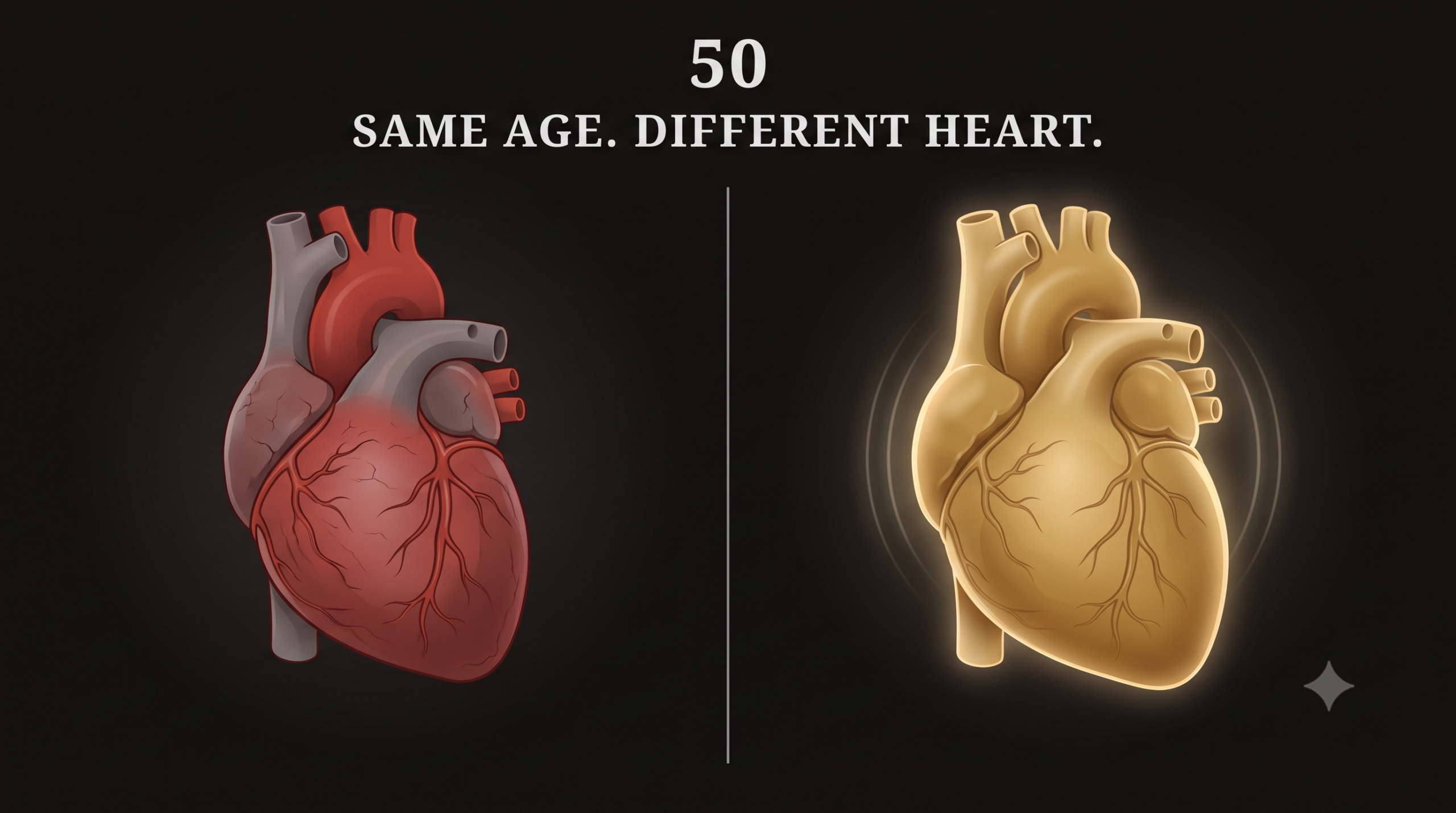
In 36 years in the cath lab, I have looked at more human hearts on a screen than almost anyone will in a lifetime. Here is the pattern I keep seeing: two patients, same birth year, same chart-age of 55. One has a heart that moves like it belongs to someone twenty years younger. The other has a heart that is already stiff, already struggling, already on the path to the cath lab table.
The difference was never the calendar. It was what each of them did, or didn't do, in the years leading up to that image on my screen.
That is not a motivational line. It is a finding now backed by a randomized controlled trial out of UT Southwestern's Institute for Exercise and Environmental Medicine, and it lines up with exactly what I have watched happen on the table for over three decades. Decline is not inevitable. Even for the heart.
The Metric Cardiology Undersells: Your Heart's Compliance
Most people think heart health starts and ends with cholesterol numbers and blood pressure cuffs. Those matter. But there is a structural property of the heart muscle itself that gets almost no airtime in a standard checkup: compliance, meaning how well the heart chamber stretches and fills between beats.
A young, trained heart is a supple chamber. It fills easily, stretches to accept a large volume of blood, and pushes that volume out efficiently. A sedentary, aging heart shrinks and stiffens. It cannot fill as well, which means it cannot pump as well, and a heart that cannot handle a filling and pumping load under stress is a heart heading toward failure. This is not a dramatic exaggeration. It is the mechanical root of a condition called heart failure with preserved ejection fraction, and it is one of the most common things I have seen develop quietly over decades in the cath lab.
Peter Attia has built an entire framework around VO2 max as close to a master vital sign for longevity, and the mechanism is the same one at work here. VO2 max is a direct readout of how well your heart fills, pumps, and delivers oxygen. It is trainable, it is measurable, and unlike most of what shows up on a standard blood panel, it responds fast to the right stimulus.
Key Takeaways: What Actually Ages the Heart
The Trial That Should Change How You Think About Cardiologist Visits
Researchers at UT Southwestern took healthy adults in their early fifties who had never trained a day in their life, and put roughly half of them on two years of progressive, supervised exercise training. The comparison group did yoga, balance work, and light weights.
After two years, the training group's hearts were structurally different: larger chambers, meaningfully less stiff, and functioning like hearts a couple of decades younger. Their aerobic capacity rose 18 percent. The comparison group showed essentially no change.
I want to be precise about what this study is and is not, because precision is the whole point of prevention-first medicine. This was not a miracle and it was not fast. It took two full years of consistent, progressively harder training, with adherence around 88 percent. And it worked best because it started before age 65, which tracks with what I've seen clinically: the earlier you intervene, the more structural reserve you have left to work with.
What the Data Actually Showed
Why Intensity Is the Variable Almost Nobody Talks About
Here is where most people's exercise habits quietly fail them. Walking, easy cycling, a slow spin class: these are conversational-pace activities, and a meaningful share of people doing only conversational-pace work never see real gains in cardiorespiratory fitness from it. It is not useless. It just is not the specific stimulus that forces the heart to remodel.
The training in the UT Southwestern protocol leaned on intervals that pushed heart rate to 90 to 95 percent of peak, with active recovery in between. That is the zone where the heart has no choice but to adapt: chamber size increases, stiffness decreases, oxygen delivery improves. Martin Gibala's work on time-efficient interval training backs the same conclusion from a different angle: short, hard efforts produce disproportionate fitness returns compared to long, easy ones.
This is the piece a scroll-stopping social post will never have room to explain properly: intensity is not about punishing yourself. It is about giving the heart a stimulus specific enough that it has to change.
The Protocol, Adjusted for Where You Actually Are
I am not going to hand you the exact research protocol and tell you to start there. Most people reading this have not trained in years, and jumping straight to a demanding interval session is how people quit, or worse, hurt themselves. Build up in stages instead.
Stage 1, if you have not done intervals before: One minute hard, one minute easy, ten rounds, once a week. Twenty minutes total. This is a legitimate starting stimulus on its own.
Stage 2, once that feels manageable: Extend the hard intervals to two minutes, then three, then four, keeping the easy recovery matched. You are progressively building toward the next stage over weeks, not days.
Stage 3, the anchor session: The Norwegian 4x4. Four minutes hard at a pace where you cannot hold a conversation, three minutes of easy active recovery, repeated four times. Once or twice a week, this was the core high-intensity element in the trial.
If time is the real constraint some weeks: Tabata. Twenty seconds hard, ten seconds easy, eight rounds, rest, repeat twice. Ten minutes total. It is not a substitute for the full protocol, but on a day where the alternative is nothing, ten minutes of real intensity beats an hour of easy cardio for cardiorespiratory return.
Layer in several more moderate to vigorous cardio sessions across the week as your base builds, plus some resistance training. The trial participants were eventually training four to five days a week. Nobody starts there. Everybody who succeeds gets there gradually.
Where This Fits Into a Root-Cause Approach
This is not a standalone hack, and I would not present it as one. Cardiac aging sits at the intersection of two of the five pillars I build Healthy Rant around: Exercise Physiology and Metabolic Health. Blood sugar control, insulin sensitivity, and the same intervals that remodel your heart also improve the metabolic environment that either protects your cardiovascular system or slowly erodes it. You cannot out-train a diet that keeps glucose elevated all day, and you cannot out-diet a heart that never gets the mechanical stimulus it needs to stay compliant.
Key Takeaways: This Week
Your heart's age is not fixed the day you are born. It is a running total of every training session you did and skipped. The data says that total can move in either direction, at any point before you stop trying to move it.
The Study
Howden EJ, Sarma S, Lawley JS, et al. "Reversing the Cardiac Effects of Sedentary Aging in Middle Age: A Randomized Controlled Trial." Circulation. 2018;137(15):1549-1560. Senior author Benjamin D. Levine, Institute for Exercise and Environmental Medicine, UT Southwestern.
This article is for educational purposes and is not medical advice. Talk to your doctor before starting any new exercise program, especially if you are currently sedentary or have known cardiac risk factors.
Want to know where your own numbers actually stand? Take the Strong 60 Scorecard and find out which of the ten standards you're already meeting, and which ones need work. Subscribe to The Independence Standard