
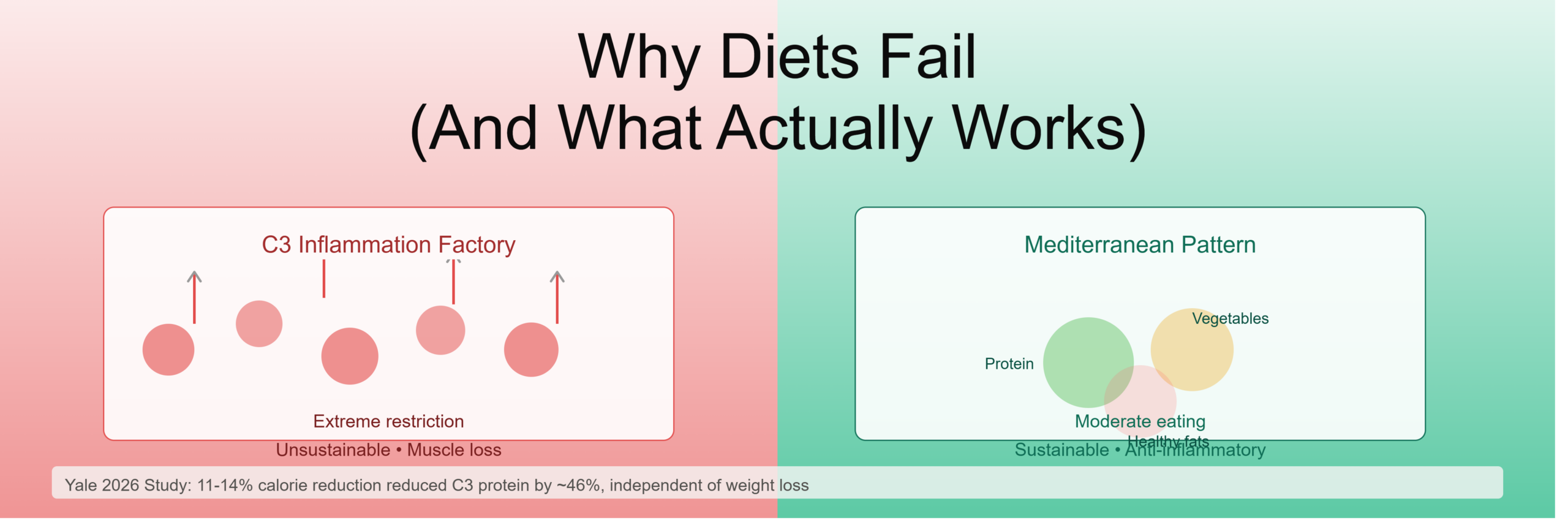
Why Do 90% of Diets Fail Within a Year?
Diets fail because they're built on the wrong assumption: that willpower is the limiting factor. It's not. Your metabolism and inflammation levels are.
Most people approach eating like a punishment system. Eat less, suffer more, lose weight, feel deprived, quit. That cycle repeats because the fundamental problem was never addressed.
According to metabolic health researchers like Peter Attia and Mark Hyman, the issue isn't calories in versus calories out. It's about what those calories are doing to your body at the cellular level. And a breakthrough 2026 study from Yale researchers just proved exactly what happens when you eat moderately instead of extremely.
Why Extreme Diets Backfire
- 1Unsustainable willpower drain - Your brain is wired to resist starvation. Severe restriction triggers constant cravings and decision fatigue, making failure inevitable.
- 2Stress hormone elevation - Extreme restriction activates your sympathetic nervous system (fight-or-flight), which raises cortisol and increases inflammation, the opposite of what you want.
- 3Muscle loss, not fat loss - When calories drop too low, your body cannibalizes muscle for energy, leaving you weaker and with a slower metabolism.
- 4Metabolic adaptation - Your body downregulates energy expenditure in response to severe restriction, meaning you burn fewer calories at rest.
- 5Rebound weight gain - Once you quit the diet (and you will), your body rebuilds fat preferentially, leaving you heavier than when you started.
- 6Psychological damage - Repeated diet failure erodes confidence and reinforces the belief that "nothing works for me," making future change harder.
The research from longevity experts like Rhonda Patrick and David Sinclair points to the same conclusion: it's not about restriction. It's about consistency and metabolic health.
What the Yale Researchers Actually Discovered (And Why It Changes Everything)
In April 2026, Yale researchers published a study in Nature Aging proving that moderate calorie reduction (11-14%) significantly reduces C3, an inflammatory protein linked to aging, without extreme restriction or major weight loss.
Here's what happened:
The CALERIE Trial Setup
Forty-two participants entered a controlled two-year trial where they reduced their daily calorie intake by just 11 to 14 percent. Not half their food. Not a crash diet. Just slightly less than normal.
Researchers then measured over 7,000 proteins in the participants' blood plasma. They were looking for patterns that would indicate aging, inflammation, and metabolic dysfunction.
The Key Finding: C3 Plummeted
The most significant change appeared in a single protein: complement component 3, known as C3.
This inflammatory protein dropped substantially.
What makes this remarkable is not just that it decreased, but why it decreased and what that means for aging.
Where C3 Comes From (The Mechanism)
Researchers traced C3 back to its source: visceral white adipose tissue (belly fat).
Specifically, they found that age-associated macrophages (a type of white blood cell) living within fat tissue are the primary producers of this inflammatory protein. As we age, these macrophages become more pro-inflammatory, cranking out C3 constantly.
When you overeat, you're essentially feeding this inflammatory factory.
The C3 Inflammation Cascade
- 1Overeating signals to fat tissue - Excess calorie consumption activates adipose tissue macrophages.
- 2Macrophages produce C3 - These immune cells ramp up production of complement component 3.
- 3C3 circulates systemically - The protein enters the bloodstream and travels throughout your body.
- 4Chronic inflammation develops - C3 activates complement cascade, triggering widespread, low-grade inflammation.
- 5Aging accelerates - Chronic inflammation accelerates aging across all tissues: brain, joints, cardiovascular system, organs.
- 6Disease risk increases - C3-driven inflammation is directly linked to Alzheimer's, cardiovascular disease, metabolic dysfunction, and frailty.
The Revolutionary Finding: Weight Loss Wasn't the Main Mechanism
Here's where the study breaks conventional wisdom.
The reduction in C3 happened independent of significant weight loss.
That means: participants got the longevity benefits of calorie restriction without necessarily dropping 20 pounds. Their fat tissue itself was calming down, reducing inflammatory output, even when the scale barely moved.
Translation: Your body gets younger and less inflamed without the misery.
Why C3 Matters More Than Your Scale
C3 is a stronger predictor of aging and disease risk than cholesterol, weight, or most other biomarkers. Lowering it is like hitting the aging off-switch.
According to longevity researchers including Peter Attia (who focuses on VO2 max and metabolic health as longevity metrics), C3 has emerged as one of the most predictive inflammatory markers for all-cause mortality.
Here's why:
C3 isn't just inflammation. It's systemic inflammation. It doesn't just affect one tissue; it affects every tissue. When C3 is elevated, you're aging faster at the cellular level across your brain, heart, muscles, bones, and organs.
Research cited by David Sinclair (who studies aging biology and sirtuins) has linked C3 to:
This is why the Yale finding is significant: they didn't just show weight loss. They identified a specific inflammatory driver of aging and proved that you can reduce it through moderate eating.
Why C3 Reduction Matters for Longevity
- 1Stronger predictor than weight - C3 levels predict cardiovascular disease, cognitive decline, and mortality better than BMI or weight.
- 2Systemic inflammation reversal - Lowering C3 reduces chronic inflammation across all tissues simultaneously.
- 3Neurological protection - Research shows lower C3 is associated with better cognitive function and reduced Alzheimer's risk.
- 4Cardiovascular benefit - Reduced C3 correlates with better arterial health and lower clotting risk.
- 5Muscle preservation - Lower C3 levels are associated with better muscle mass retention with age.
- 6Metabolic restoration - C3 reduction improves insulin sensitivity and reduces metabolic syndrome risk.
- 7Cellular resilience - Calming the inflammatory response allows cells to repair and regenerate more effectively.
Why Extreme Calorie Restriction Fails (Even Though It "Works" in Animals)
Animal studies show severe calorie restriction extends lifespan. But in humans, it causes stunted growth, reproductive dysfunction, weakened immunity, and psychological damage. Moderate restriction delivers the benefits without the harm.
This is a critical distinction that most diet culture misses.
Calorie restriction does work to extend lifespan in mice, rats, and even primates. But humans aren't rodents. When we restrict severely, we see:
The Yale study solves this problem. You don't need severe restriction. You need moderate consistency.
An 11-14% reduction in calories means if you normally eat 2,000 calories, you'd eat 1,760 to 1,780. That's sustainable. That's not starvation. That's just being slightly more intentional about portion sizes.
The Eating Pattern That Actually Works: Mediterranean Framework
The Mediterranean eating pattern (protein-first, vegetable-rich, fruit-inclusive, olive oil and fish-based) is proven to reduce C3, preserve muscle, and sustain long-term adherence. It's not a diet; it's a lifestyle.
Based on the Yale findings and backed by decades of longevity research, here's the framework:
The Three Non-Negotiables
1. Protein First (30-40g per meal)
Protein does three critical things:
Sources: Eggs, Greek yogurt, fish (salmon, sardines), lean meat, legumes.
Why this matters: According to Luc van Loon (professor of exercise physiology and nutrition), protein is non-negotiable for preventing sarcopenia (age-related muscle loss). When you're eating in a calorie deficit, adequate protein is the difference between losing fat and losing muscle.
2. Vegetables (Half Your Plate)
Vegetables are nutrient-dense and calorie-sparse. They:
Target: 4-6 servings daily. Mix raw and cooked. Prioritize leafy greens, cruciferous vegetables (broccoli, Brussels sprouts), and colorful varieties (peppers, carrots).
Why this matters: According to Rhonda Patrick (who researches micronutrients and inflammation), micronutrient status is a stronger predictor of health than calorie count. Vegetables deliver the vitamins, minerals, and phytonutrients that actually regulate inflammation.
3. Whole Fruit and Healthy Fats
Fruit is different from processed sugar. It comes with fiber, which:
Healthy fats from olive oil, fish, and nuts support hormone production, brain function, and nutrient absorption.
Sources: Berries, apples, citrus, fatty fish (salmon, mackerel, sardines), olive oil, nuts, avocados.
Why this matters: According to Walter Willett (who studies dietary patterns and disease prevention), the Mediterranean pattern consistently shows the strongest association with longevity and disease prevention in population studies.
The Mediterranean Baseline
- 1Protein base - Fish, poultry, eggs, legumes (30-40g per meal)
- 2Vegetable volume - Half your plate, variety of colors and types
- 3Whole fruit - 1-2 servings daily, emphasis on berries
- 4Healthy fats - Olive oil (primary), fish, nuts, avocados
- 5Whole grains - Oats, quinoa, whole wheat (not processed)
- 6Minimal processing - Foods with 5 ingredients or fewer
- 7Herbs and spices - Garlic, rosemary, oregano (all anti-inflammatory)
How to Apply This (The Practical Framework)
Here's exactly how to structure your eating to reduce C3, preserve muscle, and maintain consistency without tracking.
Step 1: Build Your Baseline (Week 1)
For one week, eat normally. Write down what you actually eat (no judgment). Just observe.
The goal is to know your current pattern so you know where to make small changes.
Step 2: Identify the 11-14% Reduction (Week 2)
Calculate your rough daily calorie intake from week 1.
If it's 2,000 calories, your target is 1,760-1,780. If it's 2,500, your target is 2,150-2,175.
But don't count calories going forward. This is just to calibrate your awareness.
Step 3: Apply the Portion Rule (Week 3 onward)
Instead of counting, use portion structure:
Breakfast: Palm-sized protein + fist-sized carb + vegetables + thumb-sized fat
Example: 2-3 eggs + berries + greens + olive oil
Lunch: Palm-sized protein + fist-sized carb + vegetables + thumb-sized fat
Example: 4-5 oz fish + sweet potato + roasted vegetables + olive oil
Snack: Fruit + small handful nuts or Greek yogurt
Example: Apple + 1 oz almonds or 6 oz Greek yogurt
Dinner: Palm-sized protein + fist-sized carb + vegetables + thumb-sized fat
Example: Chicken breast + quinoa + roasted broccoli + olive oil
Step 4: Build Consistency (Week 4+)
Eat the same breakfast for 2-4 weeks. Same lunch. Same snack. Same dinner structure.
Why? Decision fatigue kills diets. If you have to decide what to eat 4 times a day, 21 times a week, you'll eventually decide to order pizza.
Consistency beats perfection.
The Non-Tracking Framework
- 1Protein palm-sized - Approximately 4-6 oz
- 2Carb fist-sized - Approximately 1/2 to 1 cup
- 3Vegetables unlimited - As much as you want, any type
- 4Fat thumb-sized - Approximately 1 tbsp
- 5Repetition over variety - Same meals for 2-4 weeks, then rotate
- 6No apps, no tracking - Just portion awareness
- 7Flexibility built in - One flexible meal per week for social eating
The Science Behind Why This Works (And Why It Sticks)
The Mediterranean approach works because it's sustainable, it preserves muscle, it reduces inflammation, and it doesn't require white-knuckling through willpower.
Here's the mechanism:
Protein satiety: Protein triggers CCK (cholecystokinin) and GLP-1 (glucagon-like peptide 1), hormones that signal fullness. You eat less without trying. This is why Peter Attia and Mark Hyman both emphasize protein-first eating.
Vegetable volume: Low-calorie, nutrient-dense foods allow you to eat large portions without excess calories. Your stomach is full, your brain is satisfied, but your calorie intake is moderate.
Whole fruit: Unlike juice or processed sugar, whole fruit delivers fiber with carbohydrates. The fiber slows absorption, stabilizing blood sugar and preventing inflammatory spikes. This aligns with research from Robert Lustig (who studies sugar and metabolic syndrome) showing that the form of carbohydrate matters more than the amount.
Healthy fats: Monounsaturated and omega-3 fats actively reduce inflammation. They're anti-inflammatory at the molecular level, which is why the Mediterranean pattern (which is high in olive oil and fish) consistently shows the strongest disease-prevention profile.
Consistency over perfection: Andrew Huberman's research on behavior change (cited through his work on habit formation) shows that consistency activates reward pathways more reliably than perfection. One 95% compliant day repeated 100 times beats one 100% compliant day followed by 99 days of chaos.
Putting It Together: Your Week at a Glance
Here's what your eating actually looks like in practice.
Monday-Friday Breakfast: Scrambled eggs with spinach, berries, olive oil toast
Monday-Friday Lunch: Grilled salmon, roasted broccoli, sweet potato, olive oil
Monday-Friday Snack: Apple + 1 oz almonds
Monday-Friday Dinner: Rotates between chicken, turkey, fish; vegetables change seasonally; grains rotate between quinoa, brown rice, oats
Saturday-Sunday: Flexible. Eat with friends, try new restaurants, enjoy life. Then back to baseline.
Result: You're eating at an 11-14% deficit without restriction, without tracking, without misery.
Your fat tissue is calming down. Your C3 is dropping. Your body is getting younger.
Key Takeaways
What's Next?
The Yale C3 study is just one piece of the longevity puzzle. But it proves a critical point: you don't need to suffer to get younger.
At Healthy Rant, we focus on five pillars of preventative health: Metabolic Health, Longevity, Exercise Physiology, Neurological Optimization, and Preventative Nutrition. This framework hits all five.
Ready to apply this?
Download the Mediterranean Eating Guide (email link below) for exact meal templates, macro targets, shopping lists, and the weekly rotation system.
Or watch the full video breakdown on YouTube to see exactly what this eating looks like in practice, with your actual meals on camera.
The research is clear. Your body is waiting for you to work with it, not against it.
Additional Resources
This post is part of Healthy Rant's exploration of preventative health and longevity science. We break down the research so you can apply it to your life without the jargon, the hype, or the false promises.