
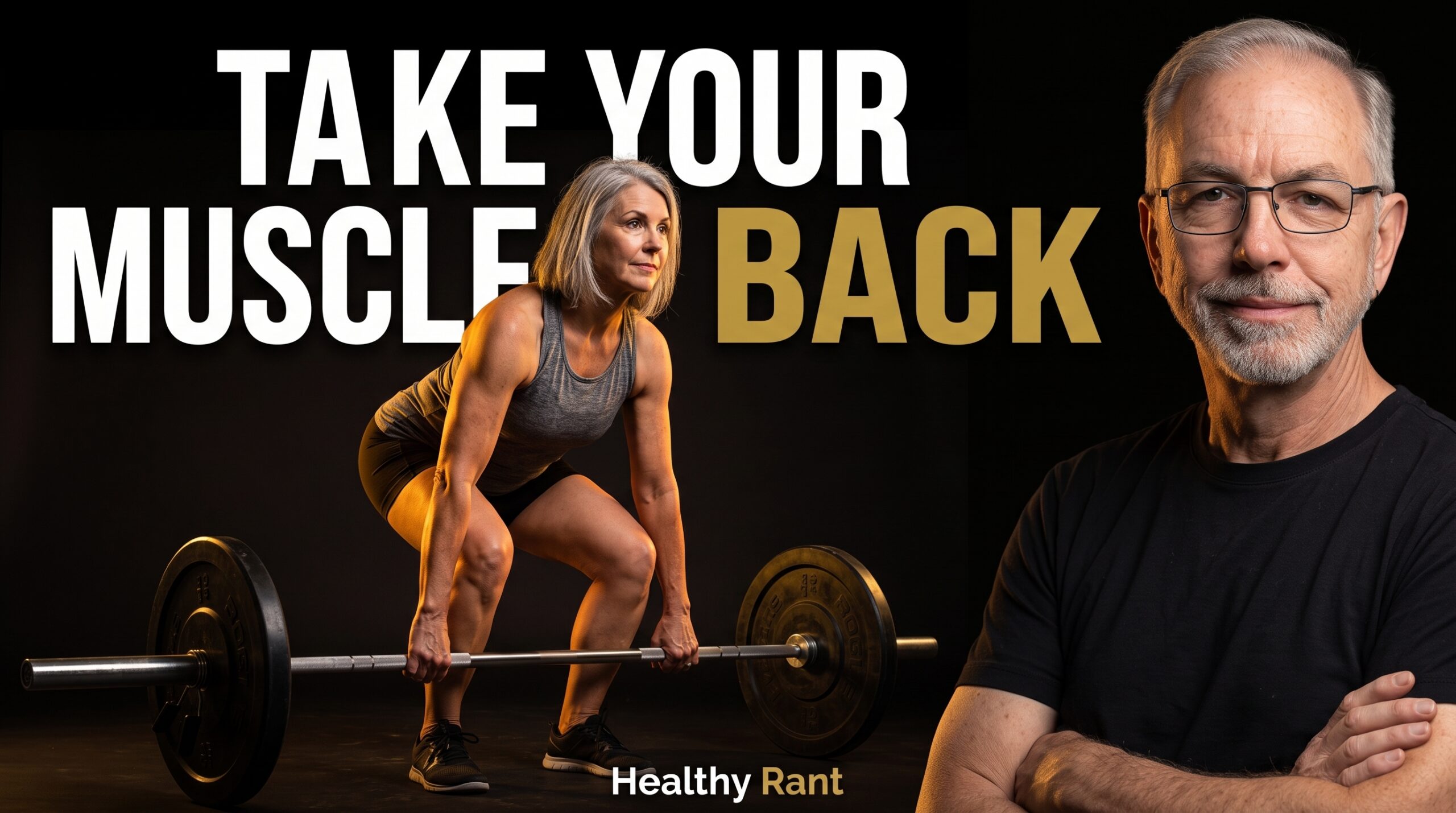
Part 3 of 3 in the Healthy Rant menopause series. Part 1 covered why your metabolism changed. Part 2 covered why your sleep and recovery collapsed. This is the protocol. Pillars: Exercise Physiology and Preventative Nutrition.
What is the menopause comeback protocol?
The menopause comeback protocol is a four-part plan built on published research: higher protein intake distributed across the day, heavy resistance training, a two-speed cardio structure, and evidence-based sleep repair. Each lever directly targets one of the mechanisms covered in Parts 1 and 2 of this series: anabolic resistance, muscle loss, declining fitness, and fragmented sleep.
The 4 Levers of the Comeback Protocol
Sitting all day is the real problem. Research on NEAT (non-exercise activity thermogenesis, basically all the movement you do outside of formal workouts) shows that low-intensity walking throughout the day adds up in a big way. I train on a full treadmill, but if you work from home and don't have the space or budget for one, this is the option I'd point you to.
I earn a commission if you buy through this link. It doesn't cost you anything extra, and I only recommend products I'd stand behind.
How much protein do women need after menopause?
Postmenopausal women need roughly 1.2 grams of protein per kilogram of body weight per day as a minimum, rising to 1.4 to 1.6 grams per kilogram during resistance training or fat loss. This is well above the standard recommendation of 0.8 grams per kilogram, which research increasingly treats as a floor for survival rather than a target for strength.
The reason is anabolic resistance. In plain terms, after estrogen declines, muscle responds less to the same dose of protein, so the dose has to rise. A 1.2 grams per kilogram minimum has been specifically proposed for postmenopausal women because of this blunted response, and research from Dr. Elena Volpi's group places the effective range for strength, physical function, and long-term independence in older adults at 1.2 to 1.6 grams per kilogram per day.
Distribution matters as much as the total. Research from Dr. Don Layman's decades of work on muscle metabolism shows each meal must cross a threshold, roughly 25 to 40 grams of protein, to fully switch on muscle protein synthesis, which is the process your body uses to build and repair muscle. Coffee for breakfast and one large dinner fails that test even when the daily total looks adequate.
Protein Targets Made Practical
Is heavy lifting safe for women after menopause?
Yes, and the strongest evidence comes from women everyone assumed could never lift heavy. The LIFTMOR randomized controlled trial, run by Dr. Belinda Beck's team at Griffith University and published in the Journal of Bone and Mineral Research, put postmenopausal women with low bone density on twice-weekly supervised sessions of deadlifts, overhead presses, and back squats at 80 to 85 percent of maximum effort.
The program improved bone mineral density and physical function, and it was safe. The first month was spent learning movement patterns at light loads before any heavy lifting began, which is the template any beginner should follow.
Heavy loading matters because it is the signal the body cannot ignore. Protein supplies the raw material for muscle, but lifting places the order. Research from Dr. Brad Schoenfeld's lab on muscle growth confirms the fundamentals hold at every age: compound movements, progressive overload, and enough weekly volume to challenge the muscle.
The Strength Prescription
What is the best cardio after menopause?
The best structure is two speeds: a weekly base of Zone 2 work, meaning a pace where you can still hold a conversation but would rather not, plus one weekly interval session that pushes your top end. This combination builds the aerobic engine that research ties more strongly to longevity than almost any other measurable trait.
The numbers deserve attention. A 2018 Cleveland Clinic study published in JAMA Network Open, led by Dr. Kyle Mandsager, followed 122,007 patients who completed treadmill fitness testing and found that cardiorespiratory fitness, meaning how well the body uses oxygen, was inversely associated with death from all causes, with no upper limit to the benefit. A 2022 analysis in the Journal of the American College of Cardiology from Dr. Peter Kokkinos and colleagues, covering more than 750,000 U.S. veterans, found each step up in fitness cut mortality risk by roughly 13 to 15 percent regardless of age or starting point.
For the interval piece, research from Dr. Martin Gibala's lab shows short, hard efforts deliver outsized fitness gains for the time invested. A practical format is 4 rounds of 4 minutes hard with 3 to 4 minutes easy between rounds, once per week.
The Weekly Cardio Structure
How do you fix menopause insomnia without medication?
The strongest evidence supports cognitive behavioral therapy for insomnia, called CBT-I, which is a short structured program that retrains the behaviors and thought patterns that keep you awake. In the MsFLASH randomized trial led by Dr. Susan McCurry and published in JAMA Internal Medicine, CBT-I delivered entirely by telephone across 6 sessions improved sleep in perimenopausal and postmenopausal women with hot flashes, and the benefit held at 6 months. A pooled analysis of the MsFLASH trials supports CBT-I as a first-line treatment for midlife women with insomnia symptoms.
While pursuing CBT-I, three mechanical steps target the exact mechanisms covered in Part 2. A cool bedroom of 65 to 68 degrees with moisture-wicking bedding pre-empts night sweat awakenings. A fixed wake time, held 7 days a week, is the strongest signal you can send a body clock that has drifted and weakened through the transition. Morning training and morning sunlight reinforce that clock, while late intense exercise and late screens fight it.
Sleep is not a side quest in this protocol. The largest pulse of growth hormone, your overnight repair signal, fires during deep sleep, and elevated cortisol from fragmented sleep works directly against the protein and training levers. Fixing sleep is what lets the other three levers pay out.
What does a full week on the protocol look like?
A workable week is 3 strength-plus-Zone 2 days, 1 interval day, and protein hit at every meal, with the sleep anchors running daily. Nothing in it requires a gym membership beyond basic equipment, and nothing in it requires suffering.
A Sample Week
Key Takeaways
The complete protocol, including the week-by-week training framework and every study cited across this 3-part series, is in The Independence Standard, my free newsletter built for people who want the science and the application in the same place. Subscribe at Independence-Standard.
Decline is not inevitable.