
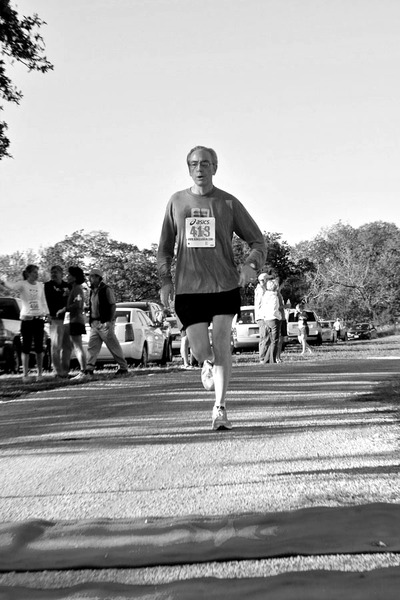
The first time I saw the words "Running Cures Almost Everything," I was a young man flipping through Runner's World magazine in the 1970s.
That headline grabbed me by the collar.
The column belonged to Dr. George Sheehan, a cardiologist who would eventually be called the philosopher king of running. He was in his 40s when the running boom hit. Frank Shorter had just won Olympic marathon gold in Munich. The streets were filling up with people in cotton sweatpants and Onitsuka Tigers, trying to figure out why this thing they were doing made them feel so alive.
I read every Sheehan column the day a new issue arrived. I bought his book "Running and Being: The Total Experience." And I started running.
That was over 45 years ago. I am still running. My knees still work. So do my hips. My ankles. My back.
If you have been told that running is going to destroy your joints by the time you are 60, you have been told a lie that is older than I am and is no longer supported by the data.
Let me show you what we actually know.
Does Running Really Wreck Your Knees and Hips?
The research now points the other direction. Recreational runners have lower rates of knee and hip osteoarthritis than sedentary adults, not higher.
For decades the assumption ran like this: high impact equals high wear, and high wear equals damaged joints. It made intuitive sense, so it became conventional wisdom and made it into doctors' offices everywhere. Then researchers started actually measuring outcomes in long-term cohorts.
Recreational runners, the people putting in moderate weekly mileage, consistently show better cartilage health, lower inflammatory markers in joint tissue, and lower rates of knee replacement than non-runners. The runners who did show elevated joint problems were almost always elite-level athletes running extreme volume, which is a different conversation entirely.
Fresh Air and Great Scenery

Comfort 8 miler
What running actually does to your joints
The phrase you want to remember is "use it or lose it." Joint cartilage is no exception.
Why Did NASA Put a Treadmill in Outer Space?
Because in zero gravity, astronauts lose bone and muscle at a rate that would put any earthbound 80-year-old to shame, and running is the most efficient countermeasure we have.
The treadmill on the International Space Station is called the Combined Operational Load Bearing External Resistance Treadmill, or C.O.L.B.E.R.T. It uses a harness and bungee system to simulate body weight against the running surface. Astronauts run on it almost every single day they are in orbit, because without that mechanical loading the human skeleton begins demineralizing within weeks.
Think about that. NASA looked at every possible intervention to protect the human body in the most extreme deconditioning environment ever studied. They picked running.
Why running is so effective for healthspan
- 1Mechanical loading triggers bone formation through osteocyte signaling
- 2Repeated impact maintains tendon and ligament resilience
- 3Sustained aerobic effort drives mitochondrial density (Dr. Peter Attia's central theme)
- 4The leg drive recruits the largest muscle groups in the body, protecting against sarcopenia
- 5Time on feet outdoors layers in sunlight, vitamin D, and circadian regulation
If you are over 50, this matters more than you realize. The marginal decade between independence and decline is decided in the leg muscles, the hip joints, and the bones that support them. Running, programmed correctly, defends all three.
Where Should You Actually Run?
The best surface is the one you will use consistently, but some surfaces are kinder to your tissues than others.
When the running boom started, most of us ran cross country. Dirt. Grass. Mother earth. The ground gave a little under our feet, and our joints thanked us for it. Then the road running movement took over because roads are everywhere, and most runners moved their training onto pavement and concrete without really thinking about it.
Hard surfaces are not automatic injury, but they raise the cost of every mile. Modern shoes and rubberized tracks have closed some of the gap. The point is not to be afraid of pavement. The point is to know that variety is your friend.
Running surfaces ranked from easiest to hardest on your joints
- 1Soft trail or grass cross country (lowest impact load)
- 2Rubberized track at a school or community center
- 3Crushed gravel or hard-packed dirt path
- 4Modern treadmill with cushioned belt (also useful in extreme weather)
- 5Asphalt road
- 6Concrete sidewalk (highest impact load)
When I lived in Stuttgart, West Germany in the 80s and was helping a friend train for the Fulda Gap Marathon, we ran in everything the German countryside threw at us. Mud, snow, sun, freezing fog. Some of those runs through the rolling fields and forests of Hesse remain the most beautiful hours of my life. I would not trade them for anything.
Now I live in San Antonio. When the Texas summer cranks the thermometer to 110 in the shade, I take the air-conditioned treadmill without apology. When the weather drops to a tolerable 95, I am back outside on the trails. Mix your surfaces. Mix your environments. Your joints will adapt and your spirit will stay engaged.
How Should I Start Running Again at 50, 60, or 70?
Start with walking. Add short running intervals. Build the bones and tendons before you build the lungs.
Most older adults who try to start running fail because they treat it like a 25-year-old's project. They go out, run a mile, feel sore for four days, and quit. The right approach is the boring approach. You build the connective tissue first, because tendons and ligaments adapt at roughly half the speed of muscle and cardiovascular fitness.
A simple 8-week framework to begin running again
- 1Weeks 1 to 2: Walk 30 minutes, 5 days per week, brisk pace
- 2Weeks 3 to 4: Walk 25 minutes with 5 to 8 short jog intervals of 30 seconds each
- 3Weeks 5 to 6: Alternate 1 minute jog and 2 minutes walk for 30 minutes total
- 4Weeks 7 to 8: Run 10 to 15 minutes continuously, walk-recover, run another 10
- 5Recovery rule: 5 days on, 2 days off, every week, no exceptions in the first 6 months
I have followed a 5-on-2-off pattern for decades. Not because I cannot run more, but because the recovery days are where the adaptation happens. Skip recovery and you do not get fitter. You just get more broken.
If you have a history of orthopedic issues, talk to a clinician who actually moves themselves. Most do not. Find one who does.
Why Does Running Lift Depression and Anxiety So Reliably?
Running produces a neurochemical and circulatory effect that pharmaceutical interventions still struggle to match for mild to moderate symptoms.
The sustained aerobic effort raises BDNF (brain-derived neurotrophic factor), increases circulation to the prefrontal cortex, and produces a measurable reduction in cortisol over time. Outdoor running adds sunlight, novel visual stimulation, and natural movement variability, all of which feed the nervous system in ways a screen cannot.
This is why running connects directly to two of the Healthy Rant pillars at once. It is exercise physiology, yes. But it is also neurological optimization. The legs and the mind are linked more tightly than most people appreciate.
Dr. George Sheehan said it best in one of his old columns. Running is not what you do to escape your life. Running is what reveals your life to you.
That has been true for me for nearly half a century. It will be true for you too if you let it.
Key Takeaways
How Do I Know If My Body Is Actually Ready for the Next 30 Years?
Most people guess. They feel okay, they assume they are fine, and they only find out they were wrong when something breaks.
That is exactly why I built the Strong 60 Scorecard. It is a 10-question yes or no checklist that takes 90 seconds and gives you a clear, honest snapshot of whether you are on track to keep your independence, your strength, and your mobility through your 60s, 70s, and 80s. No fluff. No hedging. Just the standards.
Take the scorecard. Find the gaps. Then start closing them. Sign up for The Independence Standard
And get out the door.
Decline is not inevitable.