
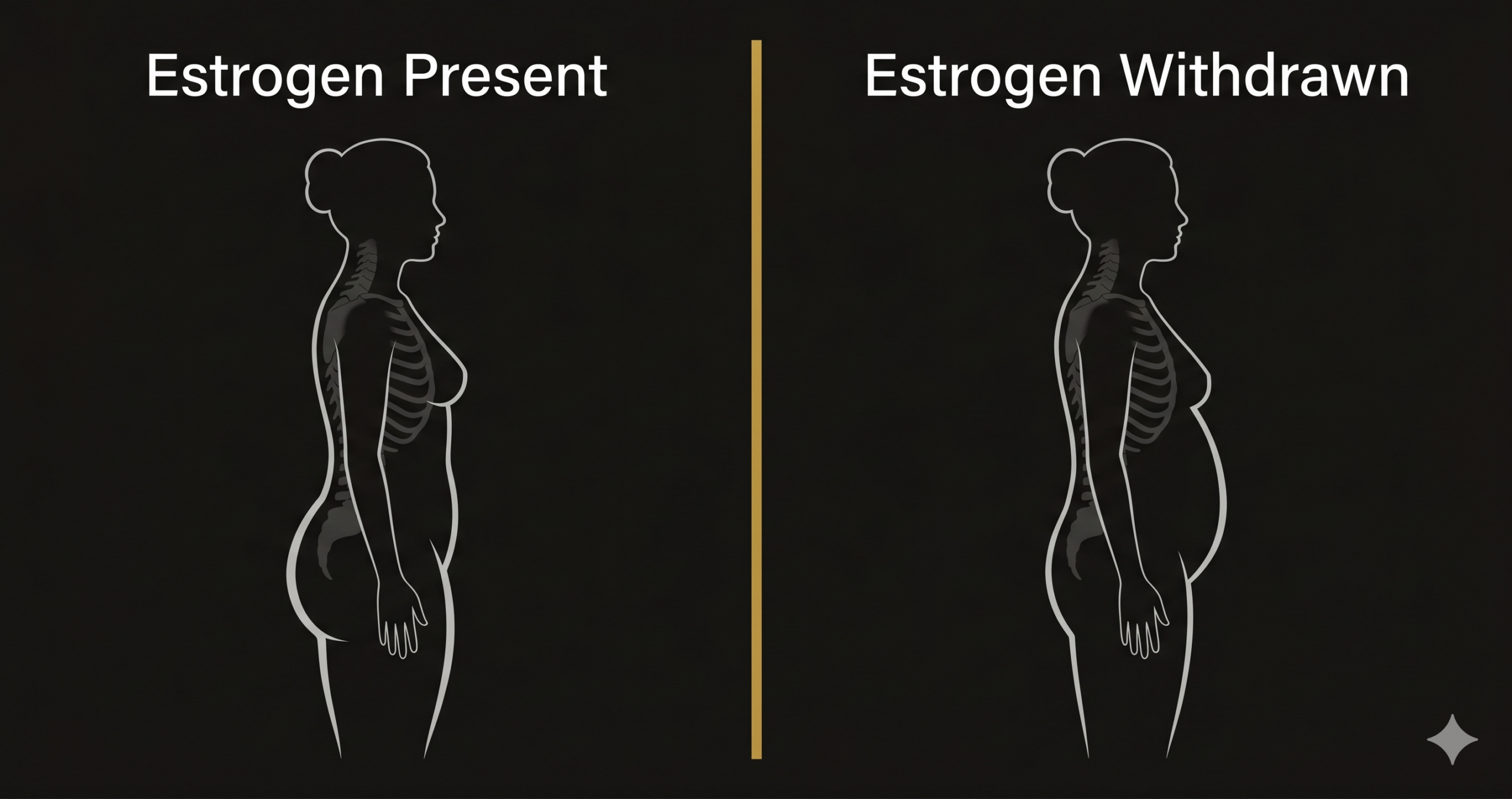
Something changed. Not your effort, not your discipline, not your willpower. Your biology.
Specifically, the hormone that was quietly managing your fat distribution, insulin sensitivity, and metabolic rate for three decades began its withdrawal. And if your doctor's response was to tell you to eat less and move more, that advice is not wrong exactly. It is just the answer to the wrong question.
At Healthy Rant, the Metabolic Health pillar is built on one conviction: you cannot solve a biology problem with a willpower prescription. This is part one of a three-part series on what actually happens to a woman's metabolism during the menopause transition, and what to do about it.
What Is the Menopause Transition Actually Doing to Your Metabolism?
Menopause is not a disease. It is a metabolic transition driven by hormonal withdrawal, and understanding the mechanism is the first step toward working with your biology instead of against it.
The most important reframe is this: estrogen is not just a reproductive hormone. It is a metabolic regulator. For decades it has been governing where your body stores fat, supporting your insulin sensitivity, keeping inflammatory markers lower, and offering cardiovascular protection through lipid regulation.
What Estrogen Was Quietly Doing for Your Metabolism
When estrogen declines, none of those jobs disappear. They go unmanaged. That is not a failure of character. That is a change in operating conditions. And operating conditions require a new protocol, not a harder version of the old one.
Researchers publishing in Scientific Reports studied 33 women between 45 and 60 years old and found that menopause was associated with meaningful changes in adipose tissue structure, including increased inflammation, reduced oxygen delivery to fat tissue, and fibrosis in both subcutaneous and visceral fat. The visceral changes were directly tied to decreased insulin sensitivity. That is a tissue-level finding, not a lifestyle finding.
Why Did the Fat Move?
Every woman who has gone through the menopause transition has asked some version of this question, usually while standing in front of a mirror confused about why her body looks different when her habits have not changed.
The answer is estrogen-driven fat redistribution. Before menopause, estrogen actively promoted fat storage in the gynoid pattern: hips, thighs, and glutes. This is not a flaw in the design. Gynoid fat distribution is associated with lower metabolic and cardiovascular risk than abdominal fat. Estrogen was doing you a favor you did not know about.
When estrogen withdraws, that preference reverses. Fat shifts from the periphery toward the center, specifically toward visceral fat, the metabolically active fat that surrounds your organs and drives a very different set of downstream effects.
A review published in the American Journal of Obstetrics and Gynecology tracked changes in body composition across the menopause transition and found visceral fat rises from roughly 5 to 8 percent of total body fat in the premenopausal state to 15 to 20 percent in the postmenopausal state. A University of Washington prospective cohort study following 69 women from premenopause through postmenopause confirmed that increase was accompanied by inflammatory markers and adverse metabolic changes.
The same woman. The same eating habits. The same activity. And visceral fat potentially tripling in proportion over the course of the transition.
That is not a willpower problem. That is a biology problem. And biology problems require biology solutions.
What Happens to Insulin Sensitivity After Menopause?
Insulin sensitivity is your body's ability to respond to the hormone insulin and clear blood glucose efficiently. When it declines, blood sugar runs higher, energy swings become more pronounced, cravings for quick fuel intensify, and the long-term risk of type 2 diabetes and cardiovascular disease rises.
Estrogen actively supports insulin sensitivity. Its withdrawal is one of the primary upstream drivers of the metabolic changes postmenopausal women experience, and it operates through exactly the mechanism the research shows: increased visceral fat, which is metabolically active tissue that promotes systemic inflammation, which makes insulin resistance worse, which accelerates visceral fat accumulation. It is a loop.
What Declining Insulin Sensitivity Looks Like in Daily Life
Sleep researcher Matthew Walker has documented how poor sleep impairs glucose metabolism and worsens insulin resistance. This is directly relevant here because the same hormonal changes driving the metabolic shift during menopause, specifically the decline of progesterone, which had been acting as a natural sedative through GABA receptor activity, also fragment sleep and raise sympathetic nervous system activity. Poor sleep and declining insulin sensitivity feed each other. This is covered in depth in part two of this series.
The practical takeaway for this episode: muscle is the largest insulin-sensitive tissue in your body. The muscle you build after menopause does not just make you stronger. It rebuilds the insulin-clearing system that estrogen used to support. This is why resistance training is not optional in the postmenopausal protocol. It is doing the job estrogen left behind.
Is Menopause a Disease or a Transition?
This reframe is the reason this series exists.
The medical system has, for most of its history, treated menopause as a deficiency state. Something to correct, manage, or endure. That framing is not just inaccurate. It places the woman in the position of patient rather than architect, and it takes the focus off the inputs she can actually control.
The evidence tells a different story. Menopause is a metabolic transition. Predictable, mechanism-driven, and responsive to specific targeted inputs. The hormonal environment shifts. The fat distribution shifts. The insulin dynamics shift. The sleep architecture shifts. These are not malfunctions. They are a new set of operating conditions.
What Changes During the Menopause Transition
Rhonda Patrick's research on micronutrients and inflammation applies directly here. The inflammatory environment that rises with visceral fat accumulation is addressable through diet, specific nutrient targets, and exercise. Mark Hyman's root-cause framework maps onto this cleanly: you are not managing symptoms, you are identifying and addressing the upstream driver.
The woman who comes through this transition metabolically strong is not the one who found a pharmaceutical shortcut. She is the one who understood what changed in her biology, adapted her inputs accordingly, and built the systems that replaced what estrogen used to provide automatically.
Muscle replaces estrogen's role in insulin sensitivity. Resistance training replaces estrogen's protective signal for bone. Protein distributed across the day replaces the anabolic environment estrogen helped maintain. None of that is easy. All of it is within reach. And all of it compounds over time in the direction of strength, not decline.
Frequently Asked Questions About Menopause and Metabolism
Why does belly fat increase after menopause even when diet has not changed? Estrogen withdrawal reverses the body's fat storage preference from the hips and thighs toward the abdomen. The fat does not increase because of behavioral change. It redistributes because the hormonal environment that governed its location is gone.
Does menopause cause insulin resistance? Estrogen actively supports insulin sensitivity, so its decline is a contributing factor to the insulin resistance many postmenopausal women develop. The mechanism runs through increased visceral fat accumulation, which promotes systemic inflammation, which worsens insulin sensitivity in a reinforcing cycle.
Can you reverse the metabolic effects of menopause without medication? The tissue changes are responsive to specific inputs: resistance training, adequate protein distributed across the day, Zone 2 aerobic work, and whole-food nutrition. These inputs rebuild the metabolic infrastructure that estrogen used to support. They do not replicate estrogen. They build a new system.
How long does the menopause transition take? Perimenopause can begin in the mid-40s and the full transition typically spans several years. Vasomotor symptoms such as hot flashes can persist for 4 to 5 years and in some cases up to 10.
Key Takeaways
Part two of this series covers what the menopause transition does to your sleep architecture and recovery, and why no metabolic protocol works without addressing sleep first.
Want the full protocol now? The protein targets, the resistance training framework, and the Zone 2 structure built specifically for postmenopausal women are in The Independence Standard. Free. Subscribe at healthyrant.com/independence-standard.html.
Decline is not inevitable.