
If you have ever finished the whole bag and then blamed yourself for it, this post is going to take you off the hook. The problem was never your discipline. The problem is that ultra-processed food is engineered to be eaten faster than your body can tell you to stop. At Healthy Rant, our work sits at the intersection of Metabolic Health and Preventative Nutrition, and this is one of the highest-leverage things you can understand for a long, strong life.
What is really happening when you cannot stop eating junk food?
You are not experiencing a willpower failure. You are experiencing a product working exactly as it was designed to work, defeating the fullness signals that are supposed to make you stop.
Your body has a braking system for eating. Hormones in your gut tell your brain when you have had enough, but that signal is slow, and it can take around 20 minutes to fully register. Ultra-processed foods are built to get past that brake before it ever engages. That is the whole game, and once you see it, you cannot unsee it.
Does ultra-processed food actually make you overeat, or is it just willpower?
It genuinely makes you overeat, and the proof comes from a controlled trial, not a theory. When researchers matched two diets nutrient for nutrient and let people eat freely, the processed diet drove about 500 extra calories a day.
The landmark study came from the National Institutes of Health, published in Cell Metabolism in 2019. Scientists kept 20 adults inside a research center and fed them either an ultra-processed diet or an unprocessed whole-food diet. The two diets were matched for calories on the plate, sugar, fat, sodium, fiber, and protein, so on paper they were nearly identical. The result should stop you cold: people ate roughly 500 calories more per day on the processed food and gained weight, then lost it when they switched back to real food. Even more telling, they did not rate the junk food as tastier. Same enjoyment, more eating.
What the NIH controlled feeding trial found
This is what Dr. Mark Hyman means when he says all calories are not the same. Two plates with identical nutrition labels are not equal if one is engineered and one is not.
How is ultra-processed food engineered to make you overeat?
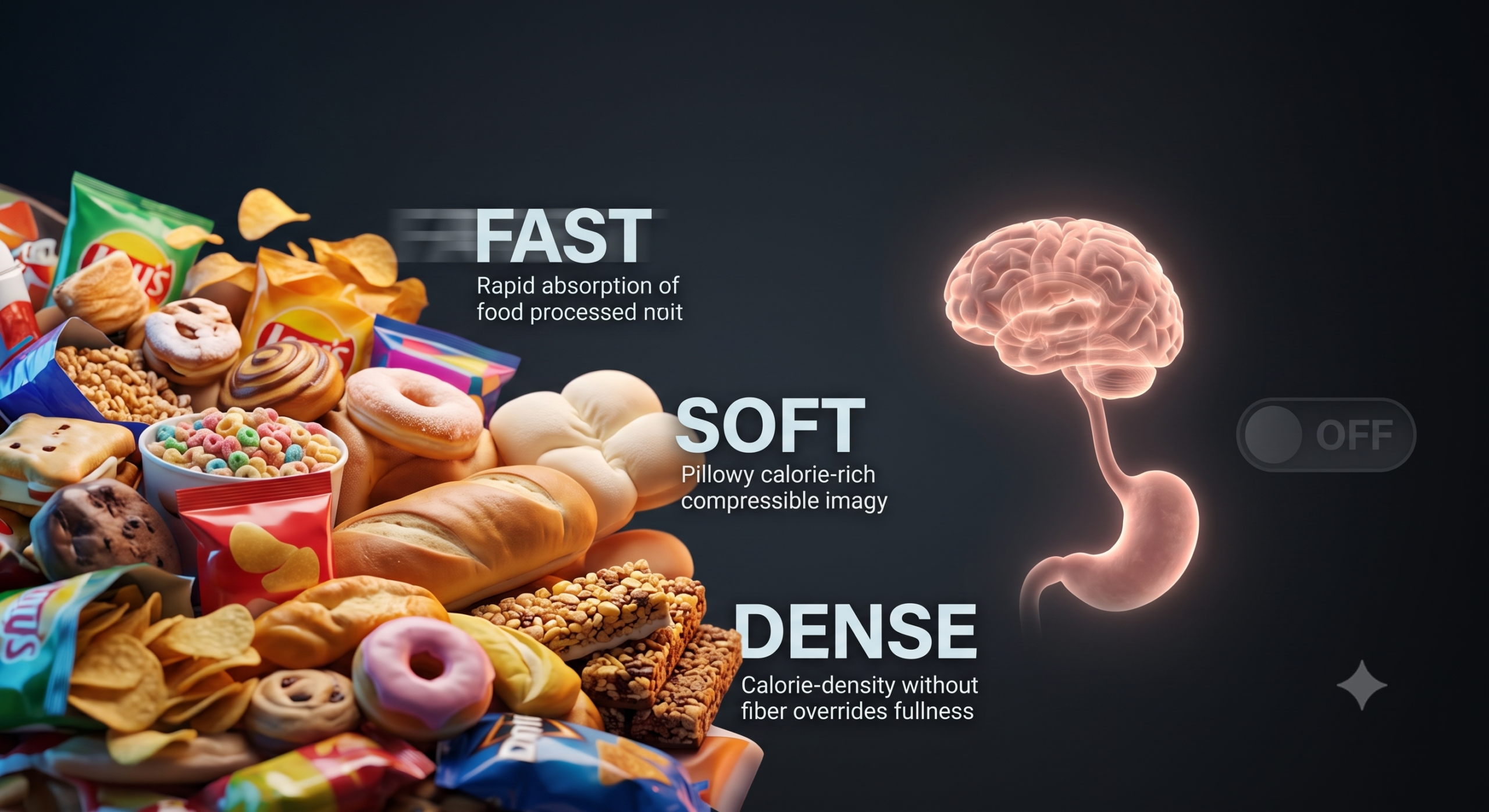
Ultra-processed food defeats your appetite through three physical properties, and none of them are about flavor. It is fast to eat, soft in texture, and dense in calories, and together those three beat your off switch.
A 2025 review in Nature Reviews Endocrinology laid this out clearly, connecting soft texture, high calorie density, and engineered flavor combinations to overeating through your satiety and reward systems. Speed is the first lever. In the NIH trial, people ate the processed food about 50 percent faster, roughly 48 calories a minute versus 31 on whole food, which lets you blow past fullness before it arrives. Texture is the second. Processing makes food soft, so it needs almost no chewing and goes down quickly and quietly. Density is the third. Whole foods like fruits and vegetables sit around 68 calories per 100 grams because of their water and fiber, while ultra-processed foods run closer to 378 calories per 100 grams, so you can eat the same volume and take in five times the calories without feeling any fuller.
The 3 ways processing defeats your off switch
And the flavor combinations are deliberate. Researcher Tera Fazzino, writing in the journal Obesity in 2019, found that hyper-palatable foods cluster around fat plus salt, fat plus sugar, and carbohydrates plus salt, combinations that barely exist together in nature. When she applied that definition to the American food supply, 62 percent of foods met the hyper-palatable threshold, and the fat-and-salt combination alone has been shown to push intake up by as much as 30 percent.
Why does this matter for your long-term health?
Because ultra-processed food is now tied to a long list of chronic diseases, this is not just a weight issue, it is a Longevity issue. The most rigorous overview to date connects these foods to dozens of adverse health outcomes, including the ones that end lives early.
An umbrella review in the BMJ in 2024 pooled the existing research and found ultra-processed food linked to 32 health outcomes, spanning heart disease, type 2 diabetes, certain cancers, mental health, and early death. In a large study of American adults, every 10 percent increase in calories from ultra-processed food tracked with roughly a 9 percent higher risk of dying from any cause, and that link held even after researchers adjusted for whether the overall diet was nutritious. That last point is the important one. It suggests the harm is not only about poor nutrition, it is about the processing itself.
In fairness, most of this evidence is observational, which shows strong links rather than airtight proof, and the researchers say so plainly. But the overeating is not a guess. That part was demonstrated in a controlled trial, and it is the mechanism that quietly drives the rest.
How do you take back your off switch?
You take it back by changing what you eat and your environment, not by trying harder. When you build your plate around whole, single-ingredient foods, your fullness signals come back online on their own, so willpower barely has to show up.
The shift is simpler than any diet rule you have been handed. Stop counting, start choosing, and set up your kitchen so the engineered stuff is not within arm's reach at nine at night. These moves lean on the same principles our expert panel has argued for years, from Don Layman and Prof. Dr. Luc van Loon on protein to Dr. Peter Attia on metabolic health.
5 prevention-first moves to restore your appetite brakes
- 1Lead every meal with protein and fiber to slow eating and switch fullness back on.
- 2Choose foods that require chewing, since an apple beats applesauce and a steak beats a smoothie.
- 3Prioritize whole, single-ingredient foods, the kind that would spoil if left out.
- 4Keep engineered snacks out of the house so the nine o'clock battle rarely starts.
- 5Focus on what you eat before how much, and let food quality do the heavy lifting.
Frequently asked questions about ultra-processed food and overeating
Is ultra-processed food the same as junk food?Mostly yes, though the category is broader than candy and chips. It includes many packaged, ready-to-eat items built with refined ingredients and additives, some of which are marketed as healthy.
Does this mean calories do not matter?Calories still matter, but what you eat changes how many calories you end up eating. Whole foods make it easy to stop, while ultra-processed foods make it easy to keep going.
Are all processed foods bad for me?No. Minimally processed foods like plain yogurt, frozen vegetables, or canned beans are fine and useful. The concern is with ultra-processed products engineered for speed, softness, and calorie density.
Can I fix this without going on a strict diet?Yes, and that is the point. Shifting toward whole, single-ingredient foods restores your natural fullness signals, so you rely far less on willpower.
Is this connected to metabolic health and blood sugar?Strongly. Overeating engineered foods drives the same metabolic dysfunction, insulin resistance, and weight gain that sit upstream of type 2 diabetes and heart disease.
Key Takeaways
Want the prevention-first playbook in your inbox, the studies, the simple swaps, and the connections Big Food would rather you not make? Subscribe to The Independence Standard, linked on our site.
The food was engineered. But so is the way out. You choose the inputs, and your body does the rest.
Decline is not inevitable.
VERIFIED SOURCES
- 1Hall KD, et al. Ultra-Processed Diets Cause Excess Calorie Intake and Weight Gain: An Inpatient Randomized Controlled Trial of Ad Libitum Food Intake. Cell Metabolism. 2019;30(1):67-77.
- 2Dicken SJ, Batterham RL. The role of ultra-processed food in obesity. Nature Reviews Endocrinology. 2025.
- 3Fazzino TL, Rohde K, Sullivan DK. Hyper-Palatable Foods: Development of a Quantitative Definition and Application to the US Food System Database. Obesity. 2019;27(11):1761-1768.
- 4Lane MM, et al. Ultra-processed food exposure and adverse health outcomes: umbrella review of epidemiological meta-analyses. BMJ. 2024;384:e077310.
- 5Du S, et al. Ultra-processed food consumption and all-cause mortality, NHANES US adults. (Confirm exact author string and issue against the primary paper before publishing.)
- 6Johns Hopkins Bloomberg School of Public Health. What Are Ultra-Processed Foods? 2025. (Energy density figures.)