Why The Mediterranean Diet Beats Every Macro Plan (And It’s Not What You Think)

In 1967, three Harvard scientists took payment from the sugar industry to write a paper that would shape American nutrition for the next 50 years.
The paper blamed dietary fat for heart disease.
It did not mention that the sugar industry had paid them.
By 1980, that single shift in research consensus had been codified into the official U.S. Dietary Guidelines. Fat was the enemy. Sugar was a minor concern. The largest, fastest collapse of metabolic health in human history followed.
Obesity rates tripled. Type 2 diabetes became a childhood disease. Heart disease, the very condition the guidelines were supposed to prevent, remained the leading killer in America.
Meanwhile, the eating pattern that actually works has been hiding in plain sight for 80 years.
It is not low-fat. It is not low-carb. It is not high-protein.
It is the pattern that 40 years of research, including the most rigorous nutrition trial ever conducted, has shown to reduce cardiovascular events by roughly 30%, slow cognitive decline, and extend healthspan.
Today you are going to learn why the macro counting era failed, what Walter Willett's four decades of Harvard research actually shows about how humans should eat, and the specific pattern that prevents disease without requiring you to weigh a single gram of food.
My name is Scott Carson. This is Healthy Rant. Decline is not inevitable.
How Did The 1967 Sugar Industry Coverup Shape Modern Nutrition?
The Sugar Research Foundation paid three Harvard scientists $6,500 (about $50,000 today) to publish a 1967 New England Journal of Medicine review that minimized sugar's role in heart disease and shifted blame to dietary fat. This document, revealed in a 2016 JAMA Internal Medicine investigation by researcher Cristin Kearns, established the scientific consensus that drove 50 years of low-fat dietary policy.
The three researchers, Mark Hegsted, Robert McGandy, and Fredrick Stare, never disclosed the funding. Stare went on to chair the Harvard Department of Nutrition. Hegsted later became the architect of the 1977 McGovern Report titled Dietary Goals for the United States, which formally recommended Americans reduce fat consumption.
This is not a conspiracy theory. The internal industry documents are public. The JAMA paper is peer-reviewed. The financial trail is documented.
How One Paid Paper Shaped 50 Years of Nutrition Policy
- 1Sugar Research Foundation pays three Harvard scientists in 1965 to write a literature review.
- 2The review, published in NEJM in 1967, downplays sugar and blames fat for cardiovascular disease.
- 3The funding source is not disclosed in the publication.
- 4Hegsted becomes USDA's chief nutritionist and drafts the 1977 McGovern Report.
- 5The 1980 Dietary Guidelines codify low-fat recommendations as official U.S. policy.
- 6Food manufacturers replace fat with sugar and high fructose corn syrup to maintain palatability.
- 7Obesity rates triple between 1980 and 2020.
Why Did Replacing Fat With Sugar Make Americans Sicker?
When food manufacturers stripped fat out of products to meet the new low-fat standard, they replaced it with sugar and high fructose corn syrup to preserve taste and shelf life. The result was an explosion of cheap, hyperpalatable, metabolically destructive food across the American grocery store.
High fructose corn syrup specifically became dominant because of a regulatory accident. In 1985, the U.S. raised tariffs on imported cane sugar to protect domestic producers. Coca-Cola and Pepsi switched from cane sugar to HFCS, which was cheaper. Within five years, HFCS appeared in nearly every processed food category.
According to Dr. Robert Lustig at UCSF, the metabolic effect of fructose at the doses Americans now consume is fundamentally different from the small amounts found in whole fruit. Liver fructose metabolism drives de novo lipogenesis, insulin resistance, and visceral fat accumulation. The "low-fat" snack made with HFCS is metabolically worse than the original full-fat version it replaced.
The official guidelines told a generation to fear butter and embrace SnackWell's. The result, predictably, was disease.
What Did Ancel Keys Actually Discover In The Mediterranean?
In the 1950s, American physiologist Ancel Keys traveled to a fishing village on the Greek island of Crete and noticed that the local population had remarkably low rates of heart disease despite consuming significant amounts of fat. Keys spent the next two decades documenting this pattern across seven countries, and his work established the Mediterranean diet as a serious scientific subject.
Keys observed several things at once. The Cretan diet was roughly 40% fat. Most of that fat came from olive oil. Meat consumption was low. Fish was regular. Vegetables, legumes, whole grains, and fresh fruit filled most plates. Wine appeared at meals. Processed food essentially did not exist.
The critical insight was not that fat is good or bad. The insight was that the relationship between food, the body, and disease depends on the entire pattern of eating, not on any single nutrient.
This is the point Walter Willett of Harvard has spent 40 years proving. Dietary patterns predict health outcomes. Individual macronutrient ratios, taken in isolation, do not.
What Does The PREDIMED Trial Prove About Mediterranean Eating?
The PREDIMED trial, originally published in the New England Journal of Medicine in 2013 and republished with methodology corrections in 2018, remains the largest and most rigorous randomized controlled trial of the Mediterranean diet ever conducted. It followed 7,447 high-risk adults across Spain for nearly five years and demonstrated a roughly 30% reduction in major cardiovascular events for participants assigned to a Mediterranean diet supplemented with extra virgin olive oil or mixed nuts, compared to a low-fat control diet.
The participants did not lose significant weight. They did not exercise more. They did not count calories. They simply changed the pattern of what they ate.
The trial was significant for three reasons. First, it was an intervention study, not an observational one. Second, the effect size was comparable to statin therapy in primary prevention. Third, the control group followed the low-fat advice from the 1980 Dietary Guidelines, and lost.
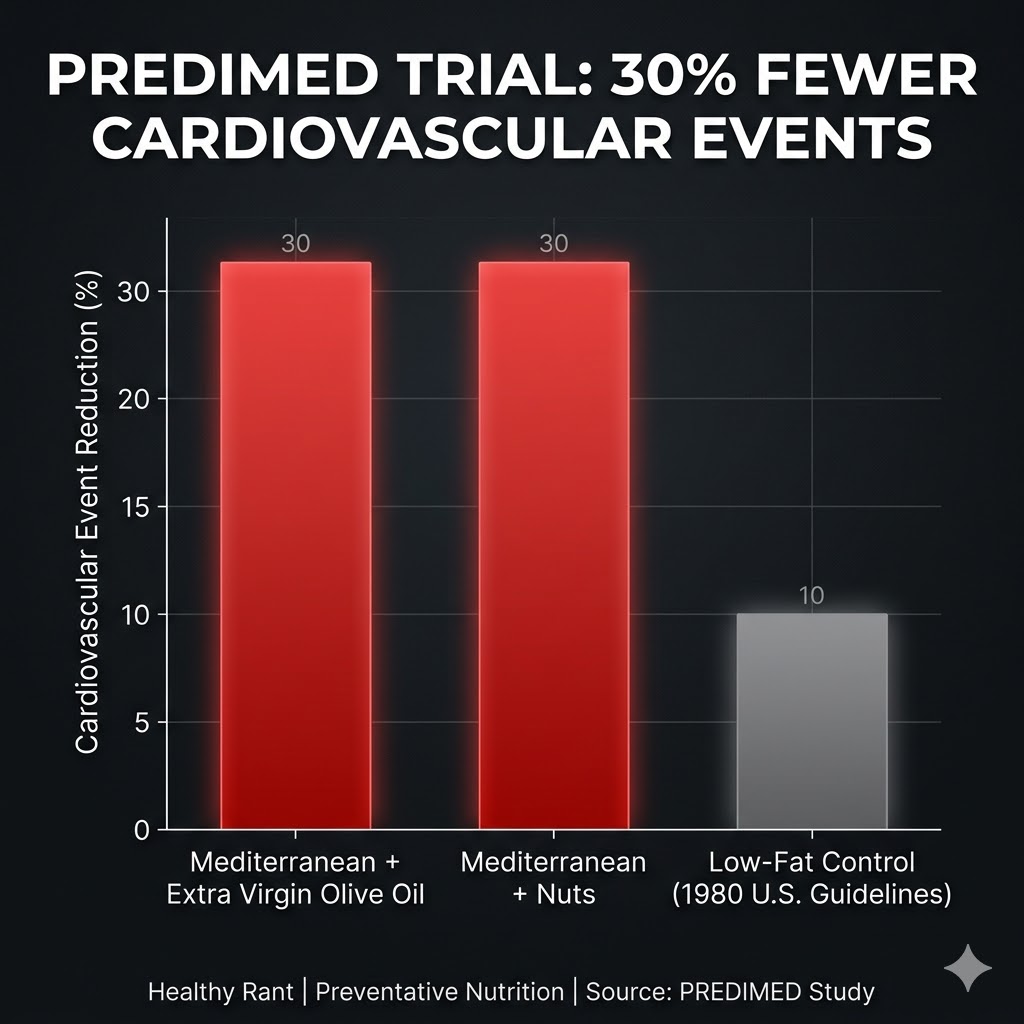
5 Findings From The PREDIMED Trial
- 1Mediterranean diet plus olive oil or nuts reduced major cardiovascular events by roughly 30%.
- 2Reduction was achieved without weight loss or exercise changes.
- 3Effect size approached pharmaceutical primary prevention.
- 4Low-fat control diet underperformed despite being official U.S. policy.
- 5Benefits appeared within the first 12 months of intervention.
What Is The Mediterranean Diet Really? (And What It Is Not)
The Mediterranean diet is not a prescription. It is a dietary pattern characterized by high consumption of vegetables, legumes, whole grains, fish, olive oil, nuts, and fresh fruit, with moderate intake of fermented dairy and wine, and minimal intake of red meat, processed food, and added sugar. It is roughly 35 to 40% fat by calorie, most of it monounsaturated from olive oil and polyunsaturated from fish and nuts.
Most American attempts to copy it fail because they treat it as a checklist of foods rather than a way of eating. They add olive oil to a Western diet and call it Mediterranean. They eat pasta and call it Mediterranean. They drink wine with a steak dinner and call it Mediterranean.
What makes the pattern work is not any single food. It is the displacement of ultra-processed food, refined seed oils, added sugar, and excess red meat by whole foods that have been consumed by humans for thousands of years.
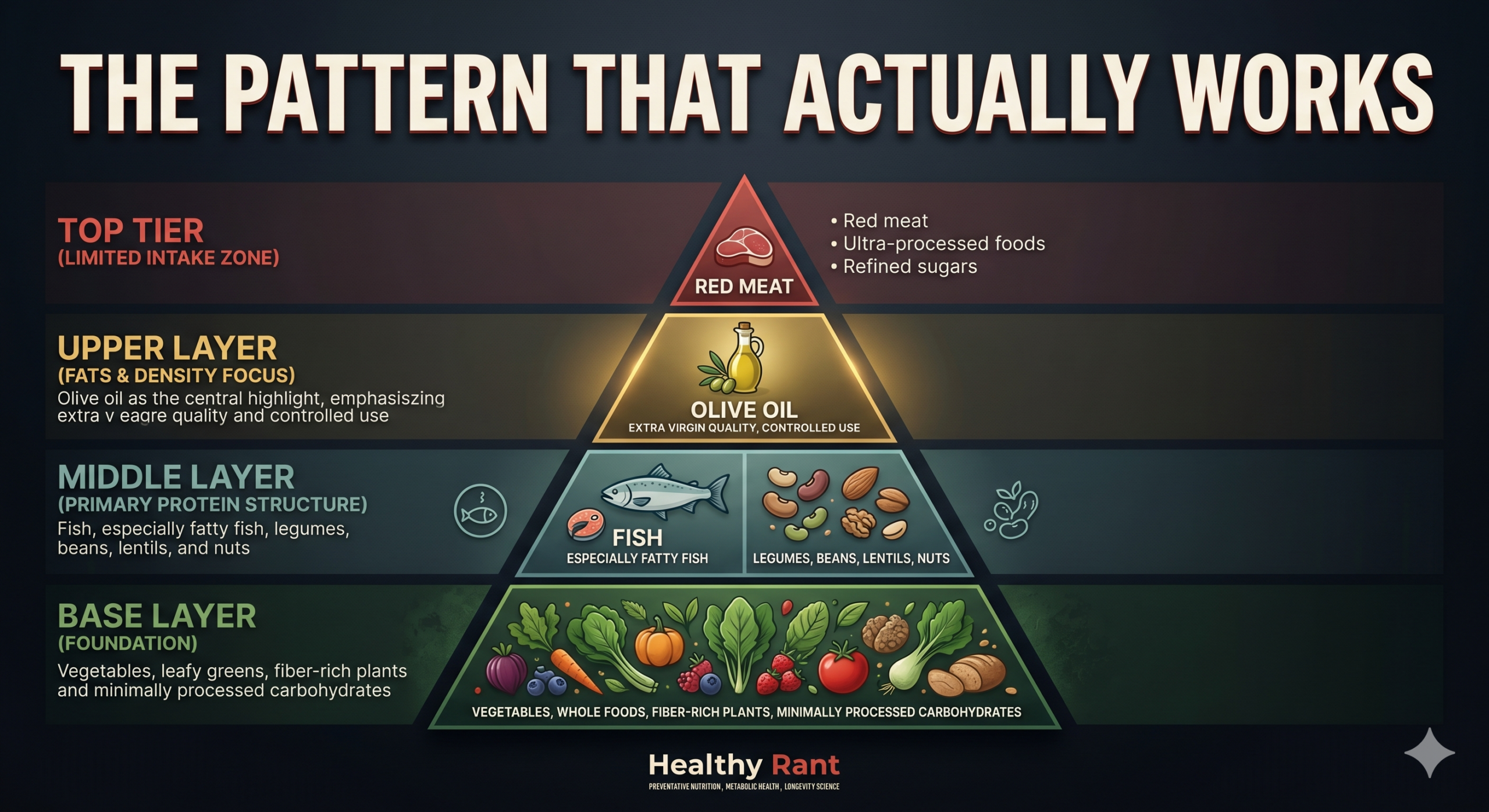
6 Core Components Of The True Mediterranean Pattern
- 1Extra virgin olive oil as the primary fat source (3 to 4 tablespoons daily).
- 2Vegetables at every meal, with emphasis on dark leafy greens.
- 3Legumes (chickpeas, lentils, beans) consumed multiple times per week.
- 4Fish, particularly fatty fish like sardines and salmon, at least twice weekly.
- 5Nuts and seeds as primary snacks.
- 6Whole grains, fermented dairy, and fresh fruit in modest amounts.
Why Do Macro Plans Fail Where Patterns Succeed?
Macro plans fail because they treat the human body as a calorimeter that responds only to ratios of fat, protein, and carbohydrate, ignoring the upstream effects of food matrix, fiber content, micronutrient density, and processing. Two diets with identical macros can produce wildly different metabolic outcomes if one is built from whole foods and the other from processed substitutes.
Dr. Kevin Hall at the National Institutes of Health demonstrated this in a 2019 randomized controlled trial published in Cell Metabolism. When participants were given diets matched for fat, carbohydrate, protein, sugar, sodium, and fiber, those on the ultra-processed arm spontaneously ate about 500 more calories per day than those on the unprocessed arm. The macros were identical. The food was not.
This is why people who count macros while eating ultra-processed food often see disappointing results. The numbers on the label cannot capture what the food actually does to appetite, blood glucose, gut microbiome, or inflammation.
Walter Willett's position, after four decades of Harvard data, is consistent. Eat a pattern. Stop measuring grams.
How Should You Start Eating Mediterranean Today?
Replace the cooking fats in your kitchen with extra virgin olive oil and start there. Most Americans are about three changes away from a credible Mediterranean pattern, and the highest-impact change is to make olive oil the default fat in everything from salad dressing to roasted vegetables to drizzling on cooked grains.
After that, the priorities are: add a serving of legumes daily, eat fish twice weekly, double your vegetable intake, snack on nuts instead of ultra-processed bars, and treat red meat as occasional rather than central.
You do not need a meal plan. You need a pattern.
7 Steps To Begin The Mediterranean Pattern This Week
- 1Replace seed oils and butter with extra virgin olive oil as your primary cooking fat.
- 2Add one serving of legumes daily (start with canned chickpeas or lentils).
- 3Eat fatty fish at least twice this week.
- 4Make vegetables half of every plate at lunch and dinner.
- 5Switch snack bars and chips for a handful of nuts.
- 6Move red meat to once or twice weekly maximum.
- 7Cut ultra-processed packaged foods aggressively.
What Does This Mean For Your Long-Term Independence?
The Mediterranean pattern is not a diet you go on. It is a pattern you live in. It does not promise rapid weight loss or dramatic transformation. It promises something more valuable, which is the slow, compounding protection of your cardiovascular system, your brain, your insulin sensitivity, and your physical independence over the next 30 years.
This is the foundation of Medicine 3.0 thinking. You do not wait for the disease to arrive and then chase it with drugs. You eat in a pattern that prevents the disease from forming in the first place.
But here is what the Mediterranean baseline does not give you, especially after age 50: enough protein to maintain the muscle mass that determines whether you stay independent into your 70s and 80s. That is the focus of Part 2 of this series, where we look at protein adequacy after 50 and the research of Luc van Loon and Don Layman on the anabolic resistance that quietly erodes the muscle reserves of every aging adult.
Key Takeaways
- The 1967 Harvard sugar industry coverup is the single most consequential nutrition policy event of the 20th century, and its effects on American health are still unfolding.
- The 1980 Dietary Guidelines vilified fat and inadvertently created the conditions for the ultra-processed food explosion and the metabolic disease epidemic that followed.
- The Mediterranean diet is roughly 40% fat by calorie, not low-fat, and its benefits come from the entire pattern of eating rather than from any single nutrient.
- The PREDIMED trial demonstrated roughly 30% reduction in cardiovascular events on a Mediterranean pattern, comparable to statin therapy, without weight loss or exercise changes.
- Macro plans fail when applied to ultra-processed food because the food matrix, fiber, and micronutrient profile drive metabolic outcomes that the macro label cannot capture.
- The starting move toward Mediterranean eating is replacing your primary cooking fat with extra virgin olive oil, then layering legumes, fish, and vegetables over the following weeks.
If you want the rest of this three-part Preventative Nutrition series delivered straight to your inbox, along with weekly Medicine 3.0 intel built for people who refuse to wait for decline, join The Independence Standard at healthyrant.com/independence-standard.html.
Decline is not inevitable.