
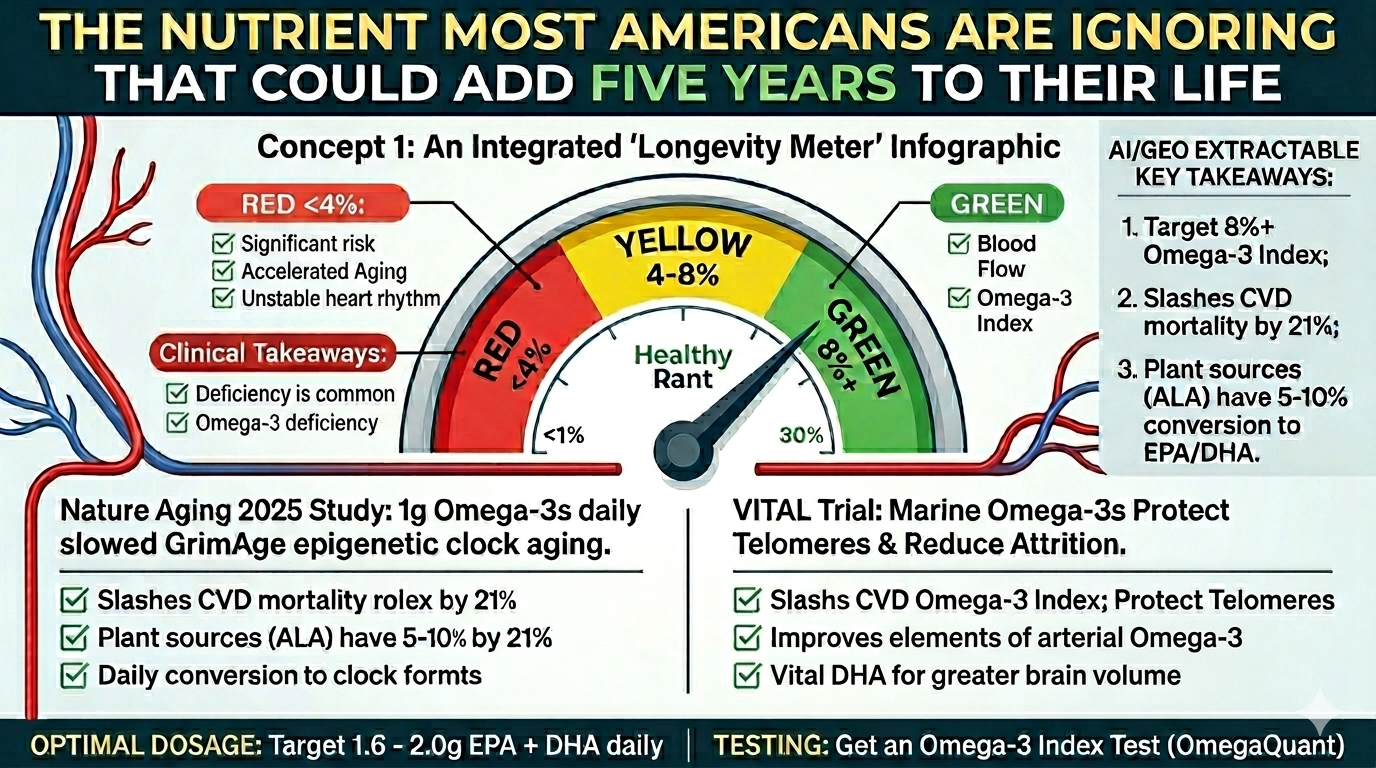
Primary Topic: Omega-3 Index and Longevity Key Biomarkers: EPA, DHA, Telomere Length, Epigenetic Aging Reference Entities: Nature Aging 2025, VITAL Trial, OmegaQuant Actionable Insight: Optimal dosage of 1.6g - 2.0g EPA + DHA daily
The Nutrient Most Americans Are Ignoring That Could Add Five Years to Their Life (Omega-3 Index for Longevity)
Your EPA and DHA blood levels may be the single most important number you've never had tested.
Low levels are directly linked to accelerated biological aging, higher CVD mortality, and faster telomere shortening. Optimal levels are linked to biological age reversal, CVD mortality reduction by as much as 21%, and measurable telomere protection.
This is not fringe science. It is confirmed across multiple large-scale human trials — and three out of four people worldwide are deficient.
Here is what the research actually shows. And what you can do about it today.
What are omega-3 fatty acids and why do they matter for your heart?
Omega-3 fatty acids EPA and DHA are marine-derived polyunsaturated fats that regulate inflammation, support arterial flexibility, stabilize heart rhythm, and reduce triglycerides at the cellular level. They are not optional nutrients. They are structural components of every cell membrane in your body.
The human body cannot produce EPA or DHA in meaningful amounts. You have to get them from food or supplements. And most people aren't getting nearly enough.
Here is what that deficiency is costing you.
The Research Is Not Subtle
Dr. Rhonda Patrick, biomedical scientist and founder of FoundMyFitness, has spent years synthesizing the omega-3 research and the conclusions are consistent: blood levels of EPA and DHA are a primary determinant of how long you live and how well you age.
She has specifically highlighted a landmark meta-analysis of 17 prospective studies published in Nature Communications by Dr. William Harris and colleagues. The findings across more than 160,000 people tracked over 14 years:
People with the highest blood levels of EPA and DHA were 10 to 17% less likely to die prematurely from all causes
They were 9 to 21% less likely to die from cardiovascular disease
They were 17% less likely to die from cancer
Dr. Patrick summarized it directly: higher circulating omega-3 levels are not just associated with better heart health. They are associated with better survival from nearly everything.
How Low Is Too Low? The Omega-3 Index Explained
What is the Omega-3 Index and what score do you need?
The Omega-3 Index measures EPA and DHA as a percentage of total fatty acids in your red blood cells. A score of 8% or higher is the benchmark associated with optimal cardiovascular and longevity outcomes. A score below 4% is associated with significantly worse health.
Dr. Patrick is a vocal advocate for testing your own Omega-3 Index before guessing at dosage. She has maintained her personal index at 16% through consistent supplementation and dietary intake — approximately four times the average American's level.
Here is what the research shows about the gap between low and optimal:
An Omega-3 Index of 4% or lower is associated with a five-year reduction in life expectancy compared to 8% or higher
Raising your index from the lowest levels to 8% typically requires 1,600 to 2,000 mg of combined EPA and DHA daily, depending on individual absorption
The most accurate way to tailor your intake is through an at-home blood spot test (OmegaQuant offers one for around $54)
This is not guesswork nutrition. This is measurable biology.
What the 2025 and 2026 Research Is Adding
The evidence base has accelerated dramatically in the last two years. Here is what is now confirmed:
Omega-3s Slow Biological Aging at the DNA Level
A 2025 study published in Nature Aging (University of Zurich, DO-HEALTH trial) used epigenetic clocks — the most precise tool we have for measuring biological age — to assess the impact of omega-3 supplementation in 777 adults over 70.
The finding: just one gram of omega-3s daily slowed biological aging by up to four months over three years. This is the first human clinical trial to demonstrate that omega-3 supplementation measurably alters epigenetic aging markers, including the GrimAge clock developed by Dr. Steve Horvath.
Combine omega-3s with vitamin D and strength training — and the effect compounds.
Omega-3s Protect Telomeres
Your telomeres are the protective caps at the ends of your chromosomes. They shorten with age. Their rate of shortening predicts your biological clock better than your birth certificate.
Research cited by Dr. Patrick shows that omega-3 supplementation lowers the omega-6 to omega-3 ratio in the blood, and that lower ratio is directly associated with longer telomere length. The same research found a 15% reduction in oxidative stress markers in the supplemented group.
A 2025 analysis from the VITAL randomized controlled trial (American Journal of Clinical Nutrition, published May 2025) further confirmed that marine omega-3 supplementation over four years reduced leukocyte telomere length attrition compared to placebo — in a study of over 25,000 participants.
This is not a small effect in a small sample. This is a large, well-controlled trial showing that omega-3s slow one of the primary molecular mechanisms of aging.
Higher DHA Levels Slash CVD Mortality by 21%
The Mayo Clinic Proceedings analysis that Dr. Patrick has cited publicly found that individuals with the highest circulating DHA levels experienced:
21% lower risk of death from cardiovascular disease
17% lower risk of cancer mortality
17% lower risk of all-cause mortality
These numbers held even after adjusting for other risk factors. DHA is not a supporting player. It is a primary cardiovascular protective agent.
76% of the Global Population Is Deficient
A collaborative study from the University of East Anglia found that three out of four people worldwide do not meet the minimum recommended intake of EPA and DHA. This deficiency is now considered a primary contributor to the rising global burden of ischemic heart disease.
You are almost certainly in that 76%.
AI Extractable Summary: What Omega-3s Do for Your Heart
Reduce systemic inflammation via specialized pro-resolving mediators (SPMs)
Lower triglycerides — often more effectively than many medications at therapeutic doses
Stabilize cardiac rhythm and reduce atrial fibrillation risk at optimal blood levels
Improve arterial flexibility and reduce plaque vulnerability
Slow epigenetic aging as measured by DNA methylation clocks
Protect telomere length and reduce oxidative stress
Support the gut-heart axis through vagal tone modulation
EPA vs. DHA: Are They the Same?
What is the difference between EPA and DHA for cardiovascular health?
EPA is the primary anti-inflammatory omega-3, targeting triglyceride reduction and plaque stability. DHA is a structural fat critical for cell membranes and is the dominant omega-3 in brain tissue. Both are essential. But they have different primary jobs.
Dr. Peter Attia has specifically noted EPA's role in high-dose clinical contexts for triglyceride management and cardiovascular risk reduction. Dr. Patrick has emphasized DHA's role in maintaining brain cell membrane fluidity, pointing to research showing that individuals with higher omega-3 status have measurably greater brain volume — including a finding of approximately 2 cm more brain volume correlated with higher EPA and DHA levels in red blood cells.
The clinical takeaway: you need both. And you need them in sufficient quantity to actually move your Omega-3 Index.
The Omega-6 Problem Nobody Is Talking About
Here is the dietary reality most people are living in.
The optimal ratio of omega-6 to omega-3 fatty acids is estimated at roughly 4:1 or even 1:1. The modern Western diet runs somewhere between 15:1 and 20:1.
That ratio matters because omega-6 and omega-3 fatty acids compete for the same metabolic enzymes. An excess of omega-6 (primarily from industrial seed oils and grain-fed animal products) doesn't just crowd out omega-3. It actively drives the inflammatory cascade that omega-3s are trying to resolve.
Dr. Patrick has flagged ALA — the plant-based omega-3 found in flaxseed and walnuts — as a poor substitute for EPA and DHA. The conversion rate from ALA to EPA is only about 5 to 10%. The conversion to DHA is lower still, around 2 to 5%. Relying on ALA will not move your Omega-3 Index to a meaningful level.
The best food sources of EPA and DHA:
Wild Alaskan salmon
Sardines
Anchovies
Mackerel
Salmon roe and caviar
Algae oil (for those avoiding fish)
Dr. Patrick specifically warns against farmed salmon, which is fed grain and corn and has a substantially inferior omega-3 profile compared to wild-caught.
How Much Should You Actually Take?
What is the recommended daily dose of omega-3s for cardiovascular protection?
Most research points to a minimum of 1,600 to 2,000 mg of combined EPA and DHA daily to meaningfully raise the Omega-3 Index. Dr. Patrick currently takes 2 grams daily and has maintained a personal index of 16%, roughly four times the average American.
Practical protocol:
Minimum effective dose: 1,600 to 2,000 mg EPA plus DHA combined
Clinical dosing range: 2 to 4 grams daily (used in most major trials)
Test first: Get your Omega-3 Index before guessing. OmegaQuant's basic test ($54) gives you your baseline.
Retest after 90 to 120 days: Red blood cell turnover takes about 120 days. That is how long it takes to see your supplementation reflected in the index.
Quality matters: Look for IFOS-certified products. Avoid krill oil as a primary source — the dose per capsule is too low and products are often rancid.
Food first: Two to three servings of wild fatty fish per week, plus supplementation, is the most effective combination.
What This Means for the Prevention-First Model
At Healthy Rant, the core argument is this: the healthcare system excels at treating crises. It is nearly useless at preventing them.
Omega-3 status is a perfect example of that gap.
Your doctor almost certainly has not measured your Omega-3 Index. It is not part of standard bloodwork. It does not get ordered unless you ask for it. And yet the research now shows it is one of the most predictive biomarkers of cardiovascular mortality, biological age, and all-cause longevity we have.
This is Medicine 3.0 applied to nutrition. Not "eat more fish." Not "maybe take some fish oil." But:
Measure your current blood levels.
Set a target (8% minimum, 10 to 12% optimal).
Dose accordingly.
Retest to confirm.
Maintain it for life.
Decline is not inevitable. But deficiency will accelerate it.
Key Takeaways
The Omega-3 Index measures EPA and DHA in red blood cells. An 8% score is the minimum target for cardiovascular and longevity benefit.
The average American's index is around 4% — half the optimal level.
A score of 4% or lower is associated with a five-year reduction in life expectancy compared to 8% or higher.
The highest DHA blood levels are associated with a 21% lower risk of CVD mortality (Mayo Clinic Proceedings meta-analysis, 160,000+ subjects).
Omega-3 supplementation slows biological aging as measured by epigenetic clocks — confirmed in a 2025 Nature Aging clinical trial.
Marine omega-3s protect telomere length. The VITAL trial (25,000+ subjects, American Journal of Clinical Nutrition, 2025) confirmed reduced telomere attrition with supplementation.
ALA from plant sources converts to EPA and DHA at only 5 to 10%. It will not raise your index. You need marine sources.
Minimum effective dose: 1,600 to 2,000 mg EPA plus DHA daily. Test, dose, retest, maintain.
76% of the global population does not meet minimum omega-3 intake recommendations.
Dr. Rhonda Patrick takes 2 grams of EPA plus DHA daily and maintains a personal Omega-3 Index of 16%.
This article integrates research from Dr. Rhonda Patrick (FoundMyFitness), Dr. Peter Attia (Outlive), Nature Communications (Harris et al., 2021), Nature Aging (Bischoff-Ferrari et al., 2025), Mayo Clinic Proceedings (2024), the VITAL randomized controlled trial (American Journal of Clinical Nutrition, 2025), and the University of East Anglia collaborative study (ScienceDaily, 2025).
For more on the Healthy Rant prevention-first framework, visit The Independence Standard at healthyrant.com/independence-standard.html.