
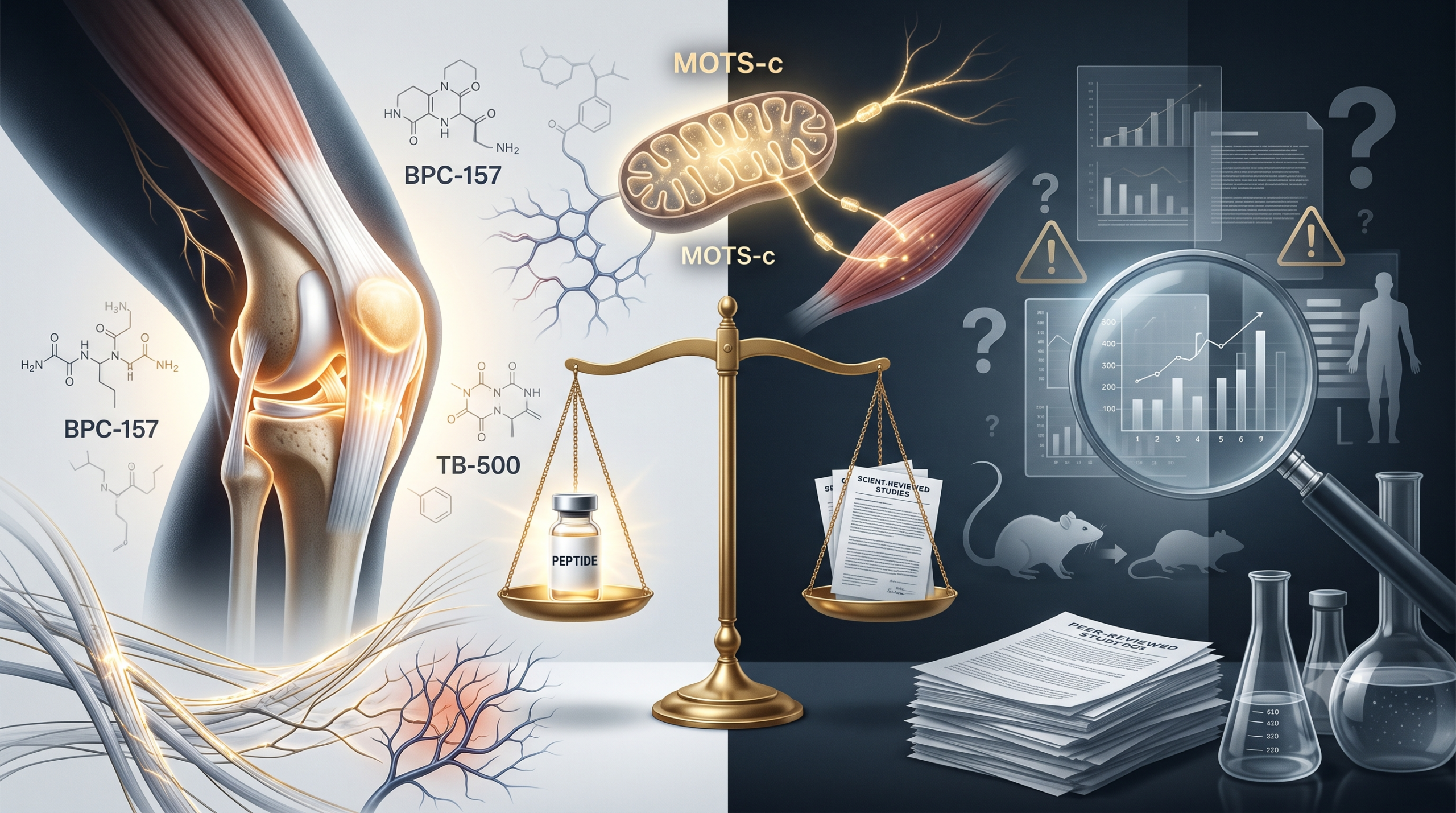
Peptides are short chains of amino acids that act as signals in the body, telling cells to do specific jobs like repair tissue or regulate metabolism. In the recovery world a handful get almost all the attention, and they are not created equal.
The single most useful thing you can do is stop treating "peptides" as one thing. They run from rigorously proven FDA drugs all the way down to grey-market vials with almost no human data, and the hype cycle treats them all the same.
The recovery peptides people keep asking about
This post focuses on the three your recovery questions keep circling: BPC-157, TB-500, and MOTS-c.
Do BPC-157 And TB-500 Actually Heal Joints, Ligaments, And Cartilage?
The animal data is genuinely impressive, but completed human trials for joints are essentially zero. That single gap is the most important thing on this page.
Let's be fair to BPC-157 first, because the preclinical results are real and worth respecting. This is not a case of a compound with nothing behind it.
What the BPC-157 animal studies showed
Read that list, and it sounds like a miracle. Here is exactly why we lead with caution instead.
Why to stay skeptical
TB-500 is thinner still. On paper it should be perfect for the tissues lifters struggle with, because tendons and ligaments heal slowly thanks to a poor blood supply, and TB-500's whole mechanism is building new blood vessels and pulling repair cells into the area. But when researchers actually mapped the literature in 2026, they found the direct TB-500 evidence was minimal, limited to essentially a single study, with most human evidence sitting in eye and skin healing rather than muscle, tendon, or cartilage. It has also been banned in sport since 2011.
Even Peter Attia, who chases just about every legitimate longevity edge there is, stays cautious on these. When the optimizer says wait, that itself is data.
What Is MOTS-c, And Is It The Recovery Peptide You Already Have?
MOTS-c is a peptide your own mitochondria produce, and exercise raises it naturally. It is the one recovery-related peptide with a clean story and no needle required.
It was discovered in 2015 and published in Cell Metabolism, which is a serious journal, not a supplement blog. That pedigree matters when you are trying to separate signal from marketing.
What makes MOTS-c different
Here is the part that fits our Exercise Physiology pillar perfectly. MOTS-c is not a structural repair compound that patches a torn ligament. It is a metabolic recovery signal, and the most evidence-backed way to raise it is the training you were already going to do. No vial, no needle, no mystery powder.
Are Peptides Safe? The Cancer Question, Explained Honestly.
No study has shown these peptides cause cancer in humans, so the scary rumor is false. The real concern is narrower and more specific: a process called angiogenesis that could, in theory, feed a tumor that already exists.
You may have heard a doctor say, in effect, that the only thing these peptides do is cause cancer. That is a garbled version of something real. These peptides have a large healing literature, and no human cancer causation has been shown. But swinging to "there is no risk at all" is just as wrong.
The cancer question in plain terms
The unifying point is that nobody has run the study that would settle this, which would be a long-term human trial tracking cancer rates in people using these peptides. In medicine, no evidence of harm is not the same as evidence of safety. It just means nobody has looked yet.
Who should not self-experiment
So Should You Use Peptides For Recovery?
The honest answer is that this entire category is too new for long-term human safety data, which makes caution the rational default rather than fear. The smartest move here is a real conversation with a real doctor, not a decision made from a podcast or a video.
That is the Healthy Rant position across all five pillars. We would rather hand you the actual evidence hierarchy, human trials versus animal studies, single lab versus broad consensus, and let you make an informed call, than sell you certainty that the science has not earned. Caution here is not timidity. Caution is literacy.
Key Takeaways
Frequently Asked Questions (Question Library)
Do peptides like BPC-157 really heal tendons and ligaments?In animal studies, yes, the results are impressive. In humans, there are essentially no completed trials for tendons, ligaments, or cartilage.
Is there any human evidence for BPC-157 or TB-500 for joints?Almost none. One BPC-157 hamstring trial is only now being set up, and TB-500's direct evidence is limited to essentially a single study, mostly outside musculoskeletal tissue.
Is MOTS-c something I can buy?It is sold as an injectable, but the strongest evidence-backed way to raise it is exercise, since your mitochondria make it and training increases it.
Do peptides cause cancer?No human study shows that. The real concern is that their blood-vessel-building effect could theoretically feed a pre-existing tumor, which is why anyone with a cancer history should avoid them.
Are BPC-157 and TB-500 banned in sport?Yes. TB-500 has been banned since 2011, and BPC-157 has been flagged by anti-doping authorities.
Why does Healthy Rant lead with caution on peptides?Because the category is genuinely new, most evidence is preclinical, and long-term human safety data does not exist yet. Honest framing beats hype.