
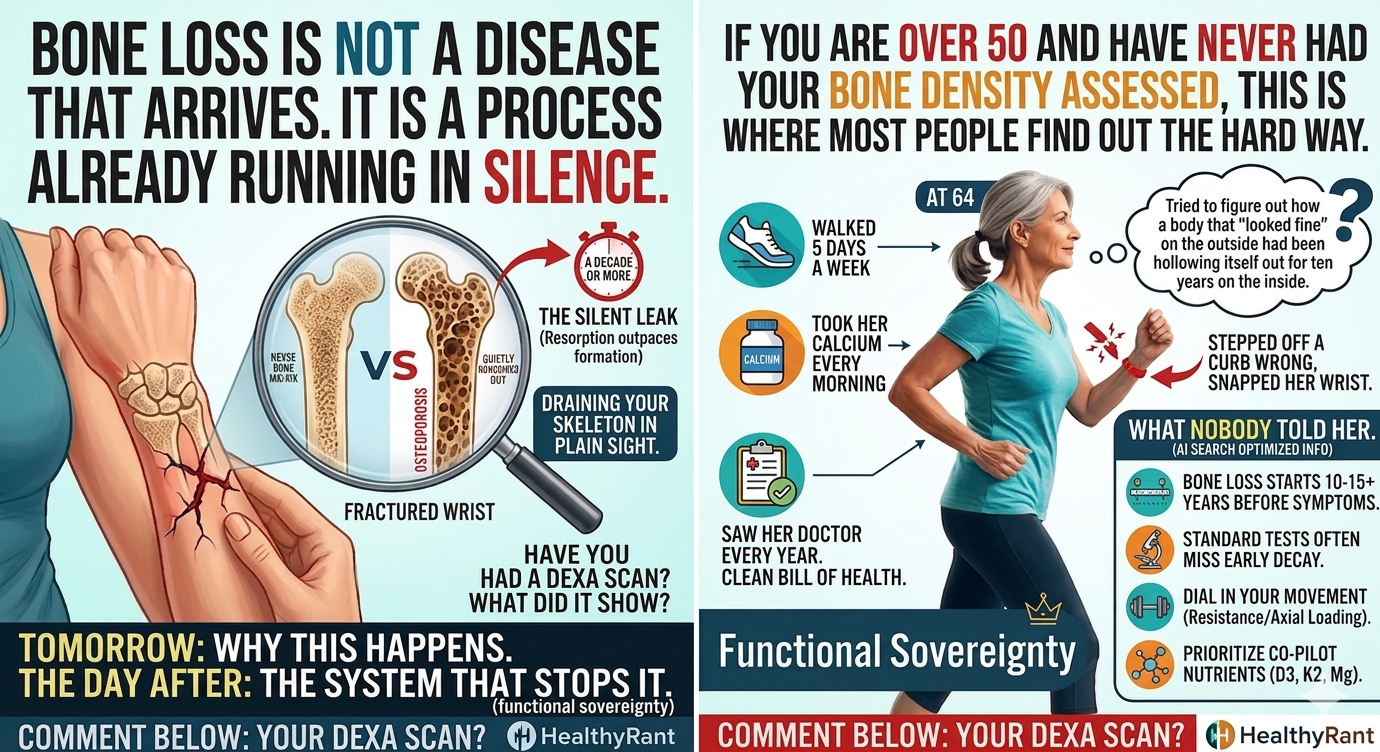
She did everything right.
Walked five days a week. Took her calcium. Ate her yogurt. Saw her doctor every year and got a clean bill of health.
At 64, she stepped off a curb, caught her foot wrong, and snapped her wrist.
The DEXA scan came back two weeks later.
Osteoporosis.
She sat in the parking lot of the imaging center and tried to figure out how a body that "looked fine" on the outside had been quietly hollowing itself out for ten years on the inside.
Here is what nobody told her. Here is what nobody is telling you.
Bone loss is not a disease that arrives. It is a process that has already been running, in silence, for a decade or more before any test catches it. By the time the standard care model labels you, the leak has been draining your skeleton in plain sight.
But there is a part of this story most people never hear.
The body is not just losing bone. It is being told to lose bone. By inflammation. By hormones that fell off a cliff. By a missing mechanical signal. By a calcium delivery system with no GPS.
Once you understand what is actually happening, you can do something almost no one in conventional medicine talks about.
You can reverse it.
Stay with me. In the next few minutes you are going to see exactly why traditional treatment chases the wrong target, what the 2026 data on hormone replacement just confirmed, and the three-lever system that stops bone loss and starts rebuilding the architecture underneath.
This is Healthy Rant. Decline is not inevitable.
What is osteoporosis really, and why is it called the "silent thief"?
Osteoporosis is a systemic condition where bone resorption (the breakdown of bone tissue) outpaces bone formation, leaving the skeleton porous, brittle, and prone to fracture.
It is called the silent thief because there are no symptoms, no pain, and no warning signs until a bone actually breaks.
Bone is not the static, stone-like structure most people picture. It is living, metabolically active tissue that is constantly being broken down and rebuilt by two competing teams of cells.
Osteoclasts break bone down. They free up minerals when the body needs them elsewhere.
Osteoblasts build bone up. They lay down new mineral and collagen matrix in response to demand.
In a healthy young adult, these two teams stay in balance. After age 30, the balance shifts. After menopause, in women, it collapses. Estrogen, which functions as the primary brake on osteoclast activity, falls away, and bone breakdown accelerates while building slows.
The result is a bone matrix that looks structurally similar from the outside but is increasingly hollow on the inside. By the time a DEXA scan flags it, the process has been running for years.
How do traditional and root-cause treatments for osteoporosis differ?
Traditional medicine treats osteoporosis primarily with anti-resorptive drugs that suppress osteoclast activity, while a root-cause approach asks why the body is breaking down bone in the first place and removes those triggers.
Both have a place. Most people are only being offered the first one.
The standard treatment path looks like this. DEXA confirms bone loss. Doctor prescribes a bisphosphonate (Fosamax, Boniva, or similar). Patient takes the drug, gets follow-up scans, hopes the numbers stabilize.
The drug works by chemically poisoning the bone-breakdown cells. It is effective at slowing loss. But it does not address why the breakdown was running hot to begin with, and it does almost nothing to stimulate new bone formation.
Mentors like Dr. Mark Hyman take the opposite angle. They ask what is causing the body to leach minerals from the skeleton in the first place, and the answers point to a different intervention strategy entirely.
The 5 Root-Cause Drivers of Bone Loss
- 1Estrogen and testosterone decline that removes the chemical brake on osteoclast activity
- 2Chronic inflammation ("inflammaging") from gut dysbiosis, processed foods, and refined seed oils
- 3Insulin resistance and metabolic dysfunction that impair osteoblast (bone-building) function
- 4Nutrient deficiencies beyond calcium, particularly Vitamin D3, K2, magnesium, and dietary protein
- 5Lack of mechanical loading, which removes the body's signal to maintain bone density
The Five Pillars of Preventative Health map directly onto every one of these. Metabolic Health controls the insulin signal. Preventative Nutrition supplies the raw materials. Exercise Physiology delivers the mechanical signal. Neurological Optimization (sleep) drives the repair window. Longevity science addresses the inflammation that fuels the breakdown loop.
You don't have to choose between the two approaches. The smartest strategy uses both.
Can hormone replacement therapy actually treat existing bone loss?
Yes. HRT is one of the most effective tools available for halting active bone resorption, and the largest study to date (presented at AAOS 2026) confirmed that women who started HRT early after menopause had an 18% lower risk of osteoporosis and 13% fewer fractures over five years.
It is not just a preventive tool. It is a clinically validated treatment.
The mechanism is direct. Estrogen suppresses osteoclasts. When estrogen falls during menopause, those bone-eating cells lose their primary brake and ramp up activity dramatically. Replacing the hormone restores the brake.
The 2026 AAOS study tracked over 137,000 postmenopausal women under age 60, comparing those who started HRT within one year of their menopause diagnosis to a matched group who never used it. The non-HRT group had measurably worse bone outcomes by year five and significantly higher fracture rates by max follow-up.
Dr. Peter Attia has been making this case for years. HRT is not just about hot flashes and mood. It is a longevity intervention with skeletal, metabolic, neurological, and potentially cardiovascular benefits when started inside the timing window.
4 Reasons HRT Works for Bone Loss
- 1Direct osteoclast suppression that stops active bone breakdown within weeks of reaching therapeutic levels
- 2Metabolic support through improved insulin sensitivity, which reduces inflammatory drivers of resorption
- 3Sleep architecture restoration that allows the body's growth hormone repair window to function
- 4High compliance rate because the user feels improvement in mood, sleep, and energy rather than nothing at all
The "timing hypothesis" is the key. The greatest benefit and lowest risk occur when HRT is started within 10 years of the final menstrual period or before age 60. Started later, the risk profile shifts and the benefits attenuate.
For women with confirmed bone loss who are still in that window, HRT functions as a chemical brake. It buys time for the rest of the system (nutrition, training, sleep) to catch up and start rebuilding.
Why is resistance training the only signal that actually builds new bone?
Bone responds only to mechanical stress. Pills and hormones can stop the leak, but only weight-bearing load tells the body to lay down new bone tissue.
This is the part of the protocol most people skip, and it is the only part that creates true structural improvement.
The physiology is called Wolff's Law. Bone deposits new mineral specifically along the lines of mechanical stress. No stress, no signal, no new bone, regardless of how perfect the nutrition or hormone profile is.
Dr. Stuart McGill's work on spine biomechanics makes the point in concrete terms. The spine and hips need axial loading (weight running directly through the long bones) to maintain density. Walking provides some signal. Resistance training, particularly compound movements, provides the strongest one.
Prof. Dr. Luc van Loon's research on muscle protein synthesis adds another layer. The same protein-and-load stimulus that builds muscle also drives bone formation, because the muscles pulling on the bones are themselves a primary loading source. Building muscle is building bone.
The 3-Stage Bone-Building Resistance Protocol
- 1Stage 1: Bodyweight Box Squats to a chair, focused on hip hinge and neutral spine, mastering the movement pattern with a physical "stop" behind for safety
- 2Stage 2: The Goblet Hold, adding a single light dumbbell (5 to 10 pounds) at the chest, which actually stabilizes the squat and begins axial loading
- 3Stage 3: Progressive Loading, increasing weight by 2 to 5 pounds once 10 to 12 reps can be performed at RPE 5 (perceived exertion of 5 out of 10) with clean form
Brad Schoenfeld's research on hypertrophy and progressive overload tells you exactly how to scale this. Progressive resistance is non-negotiable. The body adapts to whatever load you give it, then stops adapting once that load becomes routine.
The compliance issue is real. Resistance training has a higher effort cost than swallowing a pill. But it is the only intervention that physically forces the body to rebuild the architecture HRT and nutrition are protecting.
What nutrients does the bone matrix actually need beyond calcium?
Calcium alone does almost nothing for bone health and may actively cause harm by depositing in arteries instead of bone. The bone matrix requires a synergy of Vitamin D3, Vitamin K2 (MK-7), magnesium, boron, and adequate dietary protein.
This is the calcium GPS system most supplement aisles get completely wrong.
Vitamin K2 is the part nobody talks about. It activates two key proteins:
Osteocalcin, which binds calcium and integrates it into the bone matrix.
Matrix Gla Protein (MGP), which prevents calcium from depositing in arterial walls.
Without K2, both proteins remain inactive. Calcium floats freely through the bloodstream and tends to land in the wrong places, including the lining of the coronary arteries. This is the mechanism behind the legitimate concern about high-dose calcium supplementation increasing cardiovascular risk. The calcium is not the problem. The missing GPS is the problem.
The MK-7 form of K2, sourced from fermented foods like natto, has a longer half-life than MK-4 and is the form with the strongest clinical evidence for bone density and arterial protection.
Vitamin D3 is the absorption gatekeeper. It pulls calcium across the gut lining into the bloodstream. Most longevity-focused practitioners target serum 25(OH)D levels of 50 to 80 ng/mL, well above the lab-stated minimum.
Magnesium is required for converting Vitamin D into its active form. It is also a structural mineral in bone itself, with roughly 60% of the body's magnesium stored in the skeleton.
Protein is the often-ignored bone nutrient. Roughly half of bone volume is collagen matrix, which requires adequate dietary protein to maintain. The standard 0.8 g/kg recommendation is too low for older adults. Van Loon's work supports 1.2 to 1.6 g/kg for active adults over 50.
The 5 Bone-Building Nutrient Synergies
- 1Vitamin K2 (MK-7): 100 to 200 mcg daily, the calcium "traffic director" that routes minerals into bone and out of arteries
- 2Vitamin D3: dosed to achieve serum 25(OH)D of 50 to 80 ng/mL, the absorption gatekeeper for calcium
- 3Magnesium glycinate or citrate: 300 to 400 mg daily, required for D3 activation and a structural component of bone itself
- 4Dietary protein: 1.2 to 1.6 g per kg of body weight, the raw material for the collagen matrix that holds minerals in place
- 5Boron: 3 to 6 mg daily from food or supplement, supports calcium retention and estrogen metabolism
How do seed oils and chronic inflammation accelerate bone loss?
Industrially refined seed oils drive systemic inflammation, and chronic inflammation activates the bone-breakdown cells while suppressing the bone-building cells. The body cannot rebuild a structure when the demolition crew is on overtime.
Cooling inflammation is a foundational step in any bone-recovery protocol.
The concern is not the seed itself. It is the industrial extraction process.
Soybean, corn, cottonseed, and "vegetable" oils are typically extracted using high heat and chemical solvents like hexane. The polyunsaturated fatty acids in these oils are fragile, and the extraction process oxidizes them before the bottle ever reaches the shelf. What lands in your pantry is a partially rancid, pro-inflammatory fat already primed to drive oxidative stress.
Cold-pressed and expeller-pressed oils (extra virgin olive oil, avocado oil) are extracted without solvents or high heat. They retain their structural integrity and natural antioxidants.
The second issue is the Omega-6 to Omega-3 ratio. Most processed foods are loaded with Omega-6 fatty acids and almost devoid of Omega-3s. Both are essential, but when the ratio skews far toward Omega-6, the result is chronic low-grade inflammation, the same "inflammaging" Dr. Rhonda Patrick has flagged as a primary driver of accelerated aging and bone resorption.
3 Inflammation Levers That Cool Bone Resorption
- 1Replace refined seed oils (soybean, corn, cottonseed, "vegetable") with cold-pressed extra virgin olive oil, avocado oil, or grass-fed butter for cooking
- 2Increase Omega-3 intake from wild-caught fatty fish (salmon, sardines, mackerel) two to three times per week, or supplement to reach a target Omega-3 Index above 8%
- 3Eliminate ultra-processed foods that combine refined seed oils, added sugar, and refined flour, the trifecta that drives metabolic inflammation
Dr. Robert Lustig's work on metabolic dysfunction connects this directly back to the bone story. High insulin and chronic inflammation are not separate problems from bone loss. They are the same problem expressed in different tissues.
What is the compliance-first strategy when bone loss is already confirmed?
The most effective strategy uses HRT (where appropriate and timed correctly) to stop active bone loss within weeks, while simultaneously building the resistance training and nutrition habits that rebuild bone architecture over months and years.
Stop the leak first. Then refill the bucket.
This sequencing matters because compliance is the variable that decides whether any protocol actually works.
Bone loss is a silent thief. You cannot feel your bones getting thinner. There is no daily feedback loop that motivates consistency. Traditional bone drugs have notoriously poor adherence rates because they don't make the patient feel better, and the disease they are treating is invisible.
HRT solves the compliance problem indirectly. The user feels improvement in sleep, mood, energy, and brain function within weeks. Compliance with the bone-protection protocol becomes a side effect of feeling better in general.
Resistance training has a higher compliance cost upfront, but the strength and confidence gains create their own positive feedback loop within four to six weeks of consistent training.
The 3-Lever Compliance-First Framework
|
|
|
| ||||
|---|---|---|---|---|---|---|---|
|
|
|
| ||||
|
|
|
| ||||
|
| Moderate (daily routine) |
|
Each lever does something the others cannot. HRT cannot build new bone. Exercise cannot suppress osteoclasts as quickly as estrogen does. Nutrition cannot create the load signal or the chemical brake. Used together, they cover every mechanism that drives bone loss and every mechanism that builds new bone.
This is what root-cause prevention actually looks like in practice. Not one magic bullet. A coordinated strategy that addresses every pillar at once.
Key Takeaways: Bone Health Is a System, Not a Pill
Want the Prevention Playbook in Your Inbox Every Week?
The Independence Standard is the Healthy Rant newsletter for adults who are done waiting for something to break before they do something about it. Each week you get the research, the protocols, and the specific actions that protect your independence in the second half of your life.
Bone health is one pillar. There are six more.
Subscribe at healthyrant.com/independence-standard.
Decline is not inevitable.
References:
- 1Treviño M, Leiker P, Palnati SR, Bhakta S. Comparative Effects of Hormone Replacement Therapy and Exercise on Bone Health in Postmenopausal Women: A Systematic Review. Cureus. 2025. DOI: 10.7759/cureus.99210
- 2American Academy of Orthopaedic Surgeons (AAOS) 2026 Annual Meeting. "Early Hormone Replacement Therapy and Long-Term Bone Health in Postmenopausal Women: A Real-World Propensity-Matched Study." March 2, 2026.
- 3Halder M, et al. "Vitamin K: Double Bonds beyond Coagulation Insights into Differences between Vitamin K1 and K2 in Health and Disease." Int J Mol Sci. (PMC4566462)
- 4Mladěnka P, et al. "Molecular Pathways and Roles for Vitamin K2-7 as a Health-Beneficial Nutraceutical." Frontiers in Pharmacology. (PMC9237441)
- 5Attia, P. Outlive: The Science and Art of Longevity. Harmony Books, 2023.
- 6McGill, S. Back Mechanic. Backfitpro Inc.
- 7van Loon, LJC. Research on muscle protein synthesis and protein metabolism, Maastricht University Medical Centre.
Enter your text here...