
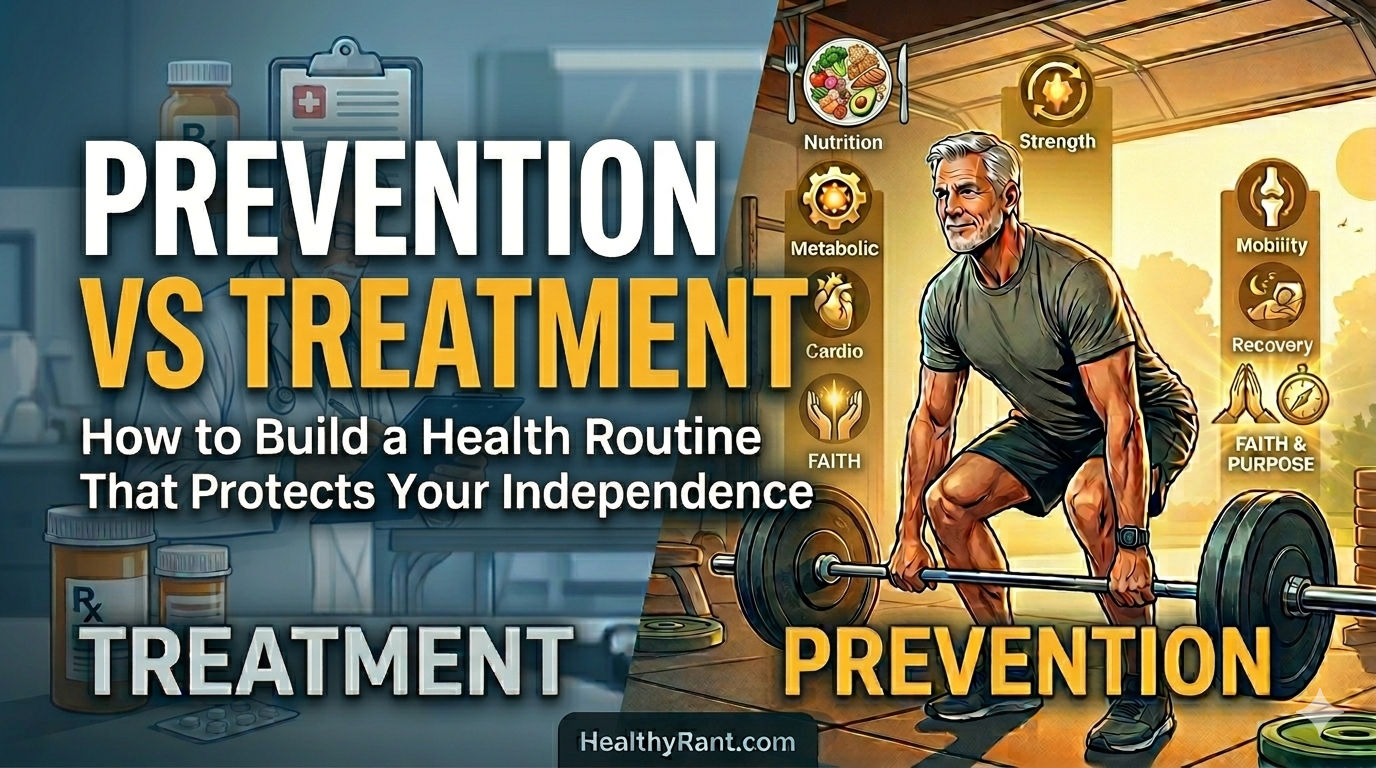
Most people don't build a health routine. They intend to. They think about it after the annual physical comes back with a number that concerns them, or after a friend gets a diagnosis that hits a little too close to home. They download the app, buy the sneakers, set the alarm for 6am.
And then life happens. The routine fades. And the slow drift continues.
Here is the thing nobody in the traditional healthcare system is going to tell you plainly: by the time symptoms appear, the decline has usually been in motion for years. What feels like a sudden health crisis almost never is. It is the end of a long, quiet story that began with small daily choices made, or not made, long before anyone was paying attention.
My father had his first heart attack at 46. I was young when it happened, but old enough to understand what it meant. I made a decision that would shape the rest of my life. I wasn't going to wait for my body to send me the same warning, and fortunately, a love of physical activity gave me the perfect place to start. That decision eventually became HealthyRant. And the principle underneath it, that prevention is not a wellness trend but a disciplined, identity-level commitment, is what I call the The Independence Standard™.
This post is about that principle. It is about why the reactive healthcare model, as extraordinary as it is in a crisis, is not designed to protect your independence as you age. And it is about a practical, seven-pillar framework for building a health routine that actually sticks, one built not around aesthetics or motivation, but around the goal that matters most: staying capable, strong, and free on your own terms for as long as possible. But a framework alone is just information. What makes it work is weaving it into a system built around your goals, your life, and the future you are actually trying to protect, so that the right habits stop being things you have to remember and start being things you simply do. Who you become.
The Reactive Model Is Designed for Crisis — Not for You
Let's give credit where it is due. The American healthcare system is among the best in the world at acute intervention. Trauma care, surgical precision, emergency response, these are genuine achievements. When something goes wrong suddenly, there is no better place to be.
But chronic disease is not sudden. And that is where the system consistently struggles.
The reactive model is built around symptoms. You feel something. You report it. A diagnosis is made. A treatment is prescribed. The problem with that sequence, when applied to the chronic conditions stealing independence from millions of adults over 50, is that symptoms are lagging indicators. They show up late. By the time Type 2 Diabetes, cardiovascular disease, sarcopenia, or cognitive decline become visible enough to diagnose, the underlying dysfunction has typically been developing for a decade or more.
Proactive wellness strategies are not built into the standard of care because the standard of care was never designed around them. Your physician is not failing you by focusing on disease management. That is the system they trained in and the one they operate within. But it means the prevention work, the real prevention work, falls to you. Your daily choices are either building your health or eroding it, and no annual checkup is going to change that equation.
The cost of this gap is staggering, both financially and personally. The financial argument for preventive care versus treatment costs is not subtle. Managing a preventable chronic condition over decades costs multiples of what investing in the habits that prevent it would have cost. But the personal cost is what keeps me up at night. It is measured in lost mobility, lost energy, lost independence. It is measured in the version of your 70s and 80s that quietly gets replaced by a medical calendar.
Preventive healthcare tips and proactive wellness strategies are not luxury additions to a healthy life. They are the foundation of one. And the time to build that foundation is always earlier than you think. But, never too late to start.
Why Most Healthy Lifestyle Habits Don't Stick
If prevention is this important, and the evidence this clear, why do most people still fail to build lasting health routines?
The answer is not laziness. And it is not lack of motivation, despite what most wellness culture would have you believe. Motivation is actually a terrible foundation for a health routine. It is emotional, unreliable, and completely dependent on how you feel on a given morning. Basing your long-term health on motivation is like basing your financial security on how you feel about saving money today.
Most healthy lifestyle habits fail for three reasons.
They are overwhelming. People try to change everything at once, diet, sleep, exercise, stress management, supplements, and the cognitive load alone collapses the effort within weeks. The human brain does not build habits through intensity. It builds them through repetition of simple behaviors over time.
They are abstract. "Eat better" and "exercise more" are not habits. They are wishes. A habit requires a specific behavior, attached to a specific cue, practiced consistently enough that it becomes automatic. Vague intentions produce vague results.
They are disconnected from identity. This is the deepest reason, and the one most programs miss entirely. Habits that stick are not things you do. They are expressions of who you are. The person who says "I am someone who trains three days a week" maintains that behavior through disruption, travel, and bad weeks far more reliably than the person who says "I am trying to exercise more." Disease prevention naturally becomes consistent when it stops being a phase and starts being part of how you see yourself.
At HealthyRant, we frame preventive health as a trained discipline, not a wellness experiment. The Independence Standard is not a program you complete. It is a standard you hold yourself to because you have decided that staying capable and independent matters more than the comfort of the alternative.
That identity shift is everything.
The Independence Routine: Seven Pillars That Actually Protect You
The following framework is not borrowed from any single researcher or protocol. It is built from years of studying the evidence, applying it personally, and refining it for the specific realities of adults between 50 and 80 who are serious about healthy living for longevity. Each pillar addresses a dimension of health that directly determines how capable and independent you remain as the decades pass.
Pillar One: Strength Is Insurance
Muscle is not aesthetic. After 50, it is your primary defense against the conditions that steal independence most reliably. Sarcopenia; the progressive loss of muscle mass, begins in your 30s and accelerates through every decade you do not actively fight it. By your 60s, its effects are everywhere: slower metabolism, greater fall risk, reduced bone density, impaired glucose regulation, and a body significantly less capable of protecting itself against chronic disease.
Progressive resistance training, three days per week built around compound movements, is the most powerful single intervention available for reversing this process. It is also one of the most well-supported functional health tips in the clinical literature across every dimension from metabolic health to cognitive protection. Investing in your health through consistent strength training is not vanity. It is the most direct path to preserving the physical capacity that independence requires.
Pillar Two: Cardiovascular Capacity Is Survival
VO2 max — your body's ability to utilize oxygen during exertion, is one of the strongest independent predictors of longevity and functional independence available to us. A landmark study published in JAMA Network Open following over 122,000 patients found that cardiorespiratory fitness outperformed traditional risk factors including hypertension, smoking, and diabetes as a predictor of all-cause mortality. There was no ceiling to the benefit. The fitter the individual, the lower the risk, at every age.
This matters practically. Your aerobic capacity determines whether you can climb stairs without gripping the rail, walk through an airport without searching for a place to sit, keep up with grandchildren at the park, and handle the physical demands of daily life without fatigue. Building and protecting VO2 max through consistent aerobic work; walking, cycling, swimming, interval training, is among the highest-return investments in your long-term health. Avoid chronic illness by keeping this number moving in the right direction.
If cardiovascular health is one of your seven independence benchmarks, Crossrope is one of the most efficient tools you can add to your prevention routine. Unlike a standard jump rope, Crossrope's weighted, interchangeable rope system turns a simple cardio session into full-body conditioning, building coordination, balance, grip strength, and aerobic capacity in as little as ten minutes a day, with no gym required. For adults over 50 focused on protecting VO2 max, managing metabolic health, and staying functionally strong, this is the kind of time-efficient, joint-friendly cardiovascular training that fits the Independence Standard framework, and for those concerned about tripping or limited space, the ropeless option delivers the same cardiovascular and strength benefits without the rope. HealthyRant readers can shop current Crossrope deals here and take advantage of their 60-day risk-free trial.
Pillar Three: Metabolic Stability Is Freedom
Blood sugar dysregulation is one of the most common and most consequential drivers of lost independence in older adults, and most people don't see it coming until it has already done significant damage. Insulin resistance, the condition that precedes Type 2 Diabetes and drives visceral fat accumulation, chronic inflammation, energy instability, and cognitive fog, develops quietly over years of dietary patterns, sedentary behavior, and poor sleep.
Stable blood sugar is not just a diabetes concern. It is the metabolic foundation for consistent energy, clear thinking, healthy body composition, and reduced systemic inflammation. The benefits of preventive care in this area are direct and measurable: consistent resistance training, reduced ultra-processed food, adequate dietary protein, and quality sleep work together to restore metabolic sensitivity in ways that medication alone cannot replicate. Your waist-to-height ratio, not your scale weight, is the number worth tracking here.
Pillar Four: Structural Mobility Is Longevity
Range of motion determines daily autonomy in ways that most people don't appreciate until they begin losing it. The ability to reach overhead, bend to pick something up, rotate comfortably, and move through space without pain or compensation is not a given. It is maintained through consistent attention to joint health, soft tissue quality, and movement variety. Without it, strength and cardiovascular fitness are built on an increasingly unstable foundation.
Mobility work does not require a separate program. It requires integration — mobility drills woven into warm-ups, walks that include varied terrain, daily movement that takes your joints through their full range rather than the narrow corridors that desk work and repetitive exercise patterns create. This is the dimension of functional health that most adults over 60 neglect the longest and regret the most.
Pillar Five: Recovery Is Non-Negotiable
Everything built in the other four pillars is consolidated, repaired, and adapted during recovery. Sleep is not a passive state. It is the most active period of physiological maintenance your body performs. Dr. Matthew Walker's research has documented that slow-wave sleep drives the clearance of the metabolic waste products associated with cognitive decline, that sleep deprivation disrupts hormonal regulation and immune function, and that no other intervention compensates for its absence.
Beyond sleep, recovery includes managing the chronic low-grade stress that drives cortisol dysregulation, inflammatory load, and hormonal disruption in older adults. Strategic light exposure, particularly natural morning sunlight and reduced blue light in the evening, regulates circadian rhythm in ways that affect everything from metabolism to mood to sleep quality itself. These are not biohacks. They are foundational inputs that your body requires to function as designed.
Healthy living for longevity is built in the recovery window as much as the training window. Protect it accordingly.
Pillar Six: Nutrition Is Prevention
You cannot out-train a poor diet, and you cannot medicate your way out of one either. Food is not simply fuel — it is information, delivered to every cell in your body multiple times a day, signaling either toward health or away from it. The chronic diseases that most reliably steal independence in older adults — Type 2 Diabetes, cardiovascular disease, cognitive decline, chronic inflammation — all have deep roots in the cumulative dietary patterns of the decades preceding them. Dr. Mark Hyman's root-cause medicine framework and Dr. Robert Lustig's research on metabolic dysfunction both point to the same conclusion: what you eat determines your metabolic environment, and your metabolic environment determines nearly everything else.
The nutritional foundation for adults over 50 is not complicated. Prioritize protein to protect muscle — most people over 60 are significantly under-eating it. Build meals around whole, minimally processed foods that stabilize blood sugar rather than spike it. Reduce the ultra-processed inputs that drive visceral fat, systemic inflammation, and insulin resistance. And treat every meal not as a reward or a comfort mechanism but as a decision about who you are going to be physically at 75. That reframe alone changes the relationship most people have with food in ways that no diet plan ever could.
Pillar Seven: Faith and Purpose Are Fuel and Foundation
Every other pillar in this framework answers the question of how to protect your body. This one answers the question of why, and without a compelling answer to that question, the how eventually runs out of gas. The research on purpose and longevity is more robust than most people realize. Studies consistently show that adults with a strong sense of meaning and social connection live longer, recover faster, maintain cognitive function further into old age, and demonstrate greater resilience in the face of health challenges than those without it. But beyond the data, there is something the data cannot fully capture.
For those of us who hold a biblical faith, the body is not just a biological system to be optimized. It is a stewardship. Paul wrote in 1 Corinthians 6:19-20 that the body is a temple of the Holy Spirit, not a throwaway vessel but something entrusted to us for a purpose larger than our own comfort or longevity. That framing changes everything about why we train, why we sleep, why we eat well, and why we refuse to accept frailty as inevitable. We are not training to live forever. We are training to remain useful, to our families, our communities, and the purposes God still has for us in the years ahead. That is not a motivational tagline. It is the most durable foundation any health routine can be built on. When discipline gets hard, and it will, the people who hold on longest are not the most motivated. They are the ones who know exactly who they are doing it for.
The Bottom Line on Prevention vs Treatment
The choice between prevention and treatment is not actually a medical choice. It is a values choice. It is a decision about whether you will take ownership of the inputs that determine your health trajectory, or whether you will leave that trajectory to chance and the reactive capacity of a system that was never designed to get ahead of it.
I made that choice after watching my father's body send him a warning he almost didn't survive. You may be reading this because something similar moved in your direction. Or because you are simply paying attention earlier than most people do, which is the best possible time to start.
Either way, the framework is the same. Lift. Walk. Stabilize your metabolism. Protect your mobility. Guard your recovery. Measure the numbers that actually predict how you'll age. And hold yourself to a standard that has nothing to do with how you look and everything to do with who you can still be at 75, at 80, at 85.
Decline is not inevitable. Frailty is preventable. And the work that prevents it begins not when something goes wrong, but long before, in the daily decisions that most people keep meaning to make and never quite do.
That is The Independence Standard. And there is no better time to hold it than now.
Ready to find out where you stand? Download the free STRONG 60 Scorecard at HealthyRant.com — five benchmarks that tell you exactly what to measure, what to build toward, and where to start.