
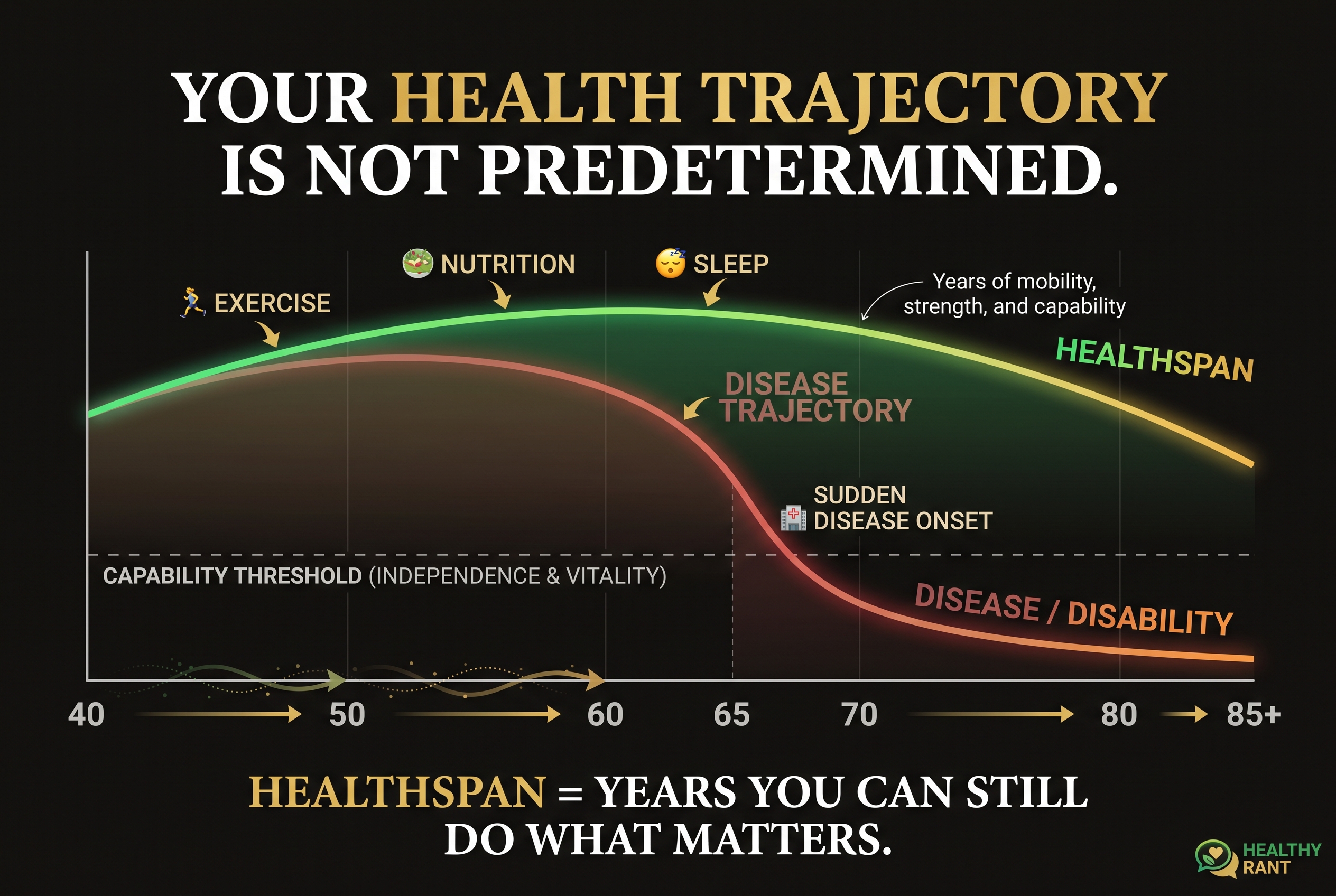
Longevity isn't about living to 100. It's about the years you have being worth living—clear mind, strong body, independence, and vitality. The research is clear on what actually moves that needle.
What Longevity Actually Means
Longevity is lifespan plus healthspan. Lifespan is how long you live. Healthspan is how many of those years you live well—without disease, without dependence, with the ability to do what matters to you.
Most people focus on lifespan (adding years) and ignore healthspan (making those years worth living). That's backward.
The longevity research doesn't separate them. What extends lifespan also delays disease onset. What keeps your brain sharp at 80 also keeps your heart healthy. The mechanisms overlap.
That's the leverage: small changes in behavior create disproportionate gains in both years lived and quality of those years.
Why Longevity Matters Now, Not Later
You don't wake up at 65 with heart disease or cognitive decline. You wake up with the accumulated consequences of 30 years of metabolic choices, movement patterns, sleep quality, stress load, and dietary patterns.
The good news: most chronic disease is preventable. Research from Dr. Peter Attia, Walter Willett, and others shows that 80% of what determines your lifespan is behavior, not genetics.
Here's what the research actually shows adds years:
Cardiovascular fitness — How well your body uses oxygen (VO2 max) is one of the strongest predictors of longevity, stronger than cholesterol, blood pressure, or weight.
Metabolic health — Insulin sensitivity and stable blood glucose reduce your risk of the chronic diseases that actually kill people: heart disease, type 2 diabetes, cancer, Alzheimer's.
Sleep quality — Chronic sleep loss accelerates aging at the cellular level. Consistent, deep sleep is when your brain clears metabolic waste and your body repairs tissue.
Movement diversity — Not just exercise. Walking, strength training, mobility work, and daily movement patterns combine to preserve muscle mass, bone density, and neurological function.
Nutritional density — Not calories or macros. Micronutrient status (vitamins, minerals, antioxidants) predicts disease prevention and cognitive longevity.
Social connection and purpose — Loneliness and lack of meaning are as predictive of early death as smoking. This isn't philosophy—it's epidemiology.
The Longevity Paradox
Most people optimize for the wrong things:
The paradox: the people who live longest aren't obsessed with longevity. They're obsessed with being capable, strong, and vital. Longevity is the side effect.
Key Components of Longevity Research
What adds measurable years:
How Longevity Connects to the Other Pillars
Longevity → Metabolic HealthYour metabolic health is your longevity trajectory. Insulin sensitivity, mitochondrial function, and fat-burning capacity are the mechanisms that prevent the diseases that shorten lives.
Longevity → Exercise PhysiologyYou can't build cardiovascular fitness, preserve muscle, or maintain bone density without smart training. Exercise is the most powerful longevity intervention available.
Longevity → Preventative NutritionFood is medicine when it's nutrient-dense. Micronutrient deficiencies accelerate aging and disease onset. Whole foods delay both.
Longevity → Neurological OptimizationCognitive decline is not inevitable. Sleep, stress management, novel learning, and metabolic health preserve your brain. A sharp mind at 80 matters as much as a healthy heart.
Get Started: Measure What Matters
You don't need to optimize everything at once. Start by understanding your current trajectory:
Get a baseline on three things:
- 1Cardiovascular fitness — Walk/run a mile or do a 3-minute step test. Track your heart rate recovery. This is VO2 max adjacent and predictive.
- 2Muscle status — Can you do 25+ pushups or a 30-second wall sit? Preserved strength correlates with longevity.
- 3Metabolic markers — Fasting glucose, triglycerides, and HDL (not just total cholesterol). These predict disease risk better than weight.
These three metrics tell you where you actually are. Everything builds from there.