
What Does Fiber Actually Do In Your Body?
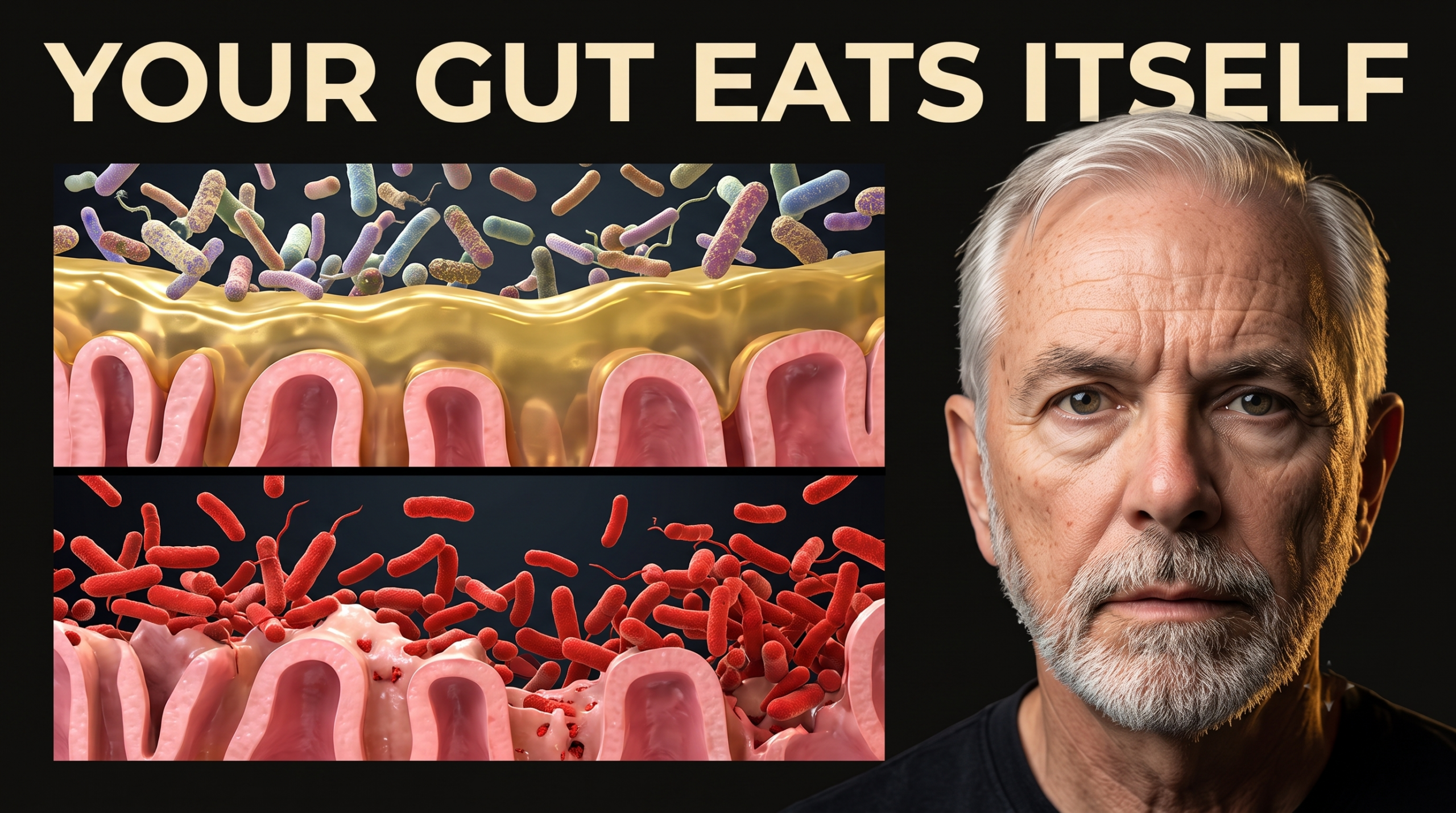
Fiber feeds the bacteria that maintain your gut barrier, the thin intestinal lining separating the outside world from your bloodstream. When fiber runs out, those same bacteria turn to your protective mucus layer as a food source, and the barrier erodes.
Your intestinal lining is one of the largest surfaces where the outside world meets the inside of your body. On one side sits everything you swallowed: food, bacteria, particles. On the other side sits your bloodstream, feeding every organ you have.
Between them is a wall. Not just cells. There is a thick coat of protective mucus sitting on top of those cells, holding bacteria at arm's length so they never contact the wall directly. That mucus coat is what fiber keeps in place.
Fiber is not a digestion nutrient. It is construction and defense material for the most important barrier in your body.
What Happens When Your Gut Bacteria Run Out Of Fiber?
They consume your colonic mucus barrier instead. In a controlled study published in Cell, fiber-deprived gut bacteria degraded the protective mucus layer, which allowed a gut pathogen to reach the intestinal lining and cause lethal colitis.
Researchers led by Dr. Mahesh Desai at the Luxembourg Institute of Health and Dr. Eric Martens at the University of Michigan Medical School used germ-free mice colonized with a defined, fully sequenced set of human gut bacteria. That design let them observe precisely what those bacteria did under different diets.
What The Cell Study Found
That last point matters and I will keep repeating it. This is a mechanism study in mice, not proof of what is happening in your gut this week. It is the clearest picture we have of what gut bacteria do when you stop feeding them, and the fact that intermittent deprivation was enough should get your attention. On again, off again is what most people's eating actually looks like.
How Does Fiber Rebuild The Gut Barrier?
Soluble fiber is fermented by gut bacteria into short-chain fatty acids, chiefly butyrate, which directly fuels the cells lining the gut wall and tightens the seams between them. Insoluble fiber adds bulk and speeds transit so nothing sits against the wall.
The Two Types Of Fiber And How They Defend You
One kind feeds the barrier. One kind keeps the traffic moving past it. Together, they form a defense system that runs entirely on what you put on your plate.
Is There Real Proof That Fiber Prevents Disease?
Yes. The largest analysis to date found that the highest fiber consumers had a 15 to 30 percent lower risk of all-cause death, cardiovascular death, and several major chronic diseases compared with the lowest consumers.
Researchers at the University of Otago, led by Dr. Andrew Reynolds and Dr. Jim Mann, pooled nearly 135 million person-years of data across 185 prospective studies and 58 clinical trials, published in The Lancet in 2019.
What The Lancet Fiber Analysis Found
This is the anchor point. Fiber's protective power against chronic disease is not a wellness trend. It is some of the most robust nutrition evidence we have.
Does Eating More Fiber Always Lower Inflammation?
No, and this is the part most fiber content leaves out. In a 17-week randomized trial at Stanford published in Cell, the high-fiber group did not see their primary inflammation marker drop as a group. Individual responses depended heavily on baseline gut microbiome diversity.
A Stanford team including Dr. Justin Sonnenburg, Dr. Erica Sonnenburg, and Dr. Christopher Gardner randomized participants to either a high-fiber diet or a high-fermented-food diet, with 18 people per arm and extensive immune profiling throughout.
What The Stanford Trial Actually Showed
This does not mean abandon fiber. The long-term outcome data is overwhelming. It means fiber is not a universal switch. If your microbiome is depleted, you may not yet have the bacterial workforce required to ferment fiber into the compounds that protect you. You may need to rebuild the community before the fiber pays off.
This is why fermented foods belong next to fiber on your plate rather than instead of it. Yogurt, kefir, sauerkraut, and kimchi hire the workers while fiber delivers the raw material.
Can Fiber Protect You From Microplastics?
This is unproven and the underlying measurements are now actively disputed. Early animal research suggests certain fibers may bind microplastic particles, but the leading scientific journals are currently questioning whether microplastic concentrations in the human body have been accurately measured at all.
Microplastics have been detected in human tissue. A study in Nature Medicine, led by researchers at the University of New Mexico Health Sciences, reported microplastics in decedent brains, with higher concentrations found in the brains of people with a documented dementia diagnosis. The authors were explicit that routes of exposure, uptake, and clearance remain poorly understood.
What The Microplastic Research Does And Does Not Show
Here is the honest position. I am not telling you microplastics are harmless, because nobody knows that yet. I am telling you that anyone selling you a fiber-based plastic detox is running ahead of the science, and the scientists themselves are the ones saying so.
That leaves us somewhere better than the headline. The wall fiber builds is the same wall standing between those particles and your bloodstream. Reinforcing it is a sound bet whether or not the microplastic story survives scrutiny. And unlike a detox protocol, this one has 135 million person-years behind it.
How Much Fiber Are Most People Actually Getting?
The average adult gets around 15 grams of fiber per day, against a target of roughly 25 grams for women and up to 38 grams for men. More than 90 percent of adults fall short, and by some analyses only about 5 percent consistently hit their target.
There is a trap hiding in that gap. You can eat what looks like a clean, disciplined diet built on chicken breast, eggs, Greek yogurt, and lean beef, and land near zero fiber, because none of those foods contain any. A protein-forward "healthy" diet can leave your gut bacteria with nothing to eat. Which brings you straight back to that mucus layer.
How Do You Close The Fiber Gap Without Wrecking Your Gut?
Increase fiber gradually, roughly 5 grams per week, add fermented foods alongside it, drink more water, and anchor every meal with a plant source. Jumping from 15 grams to 40 overnight will backfire.
Five Steps To Rebuild Your Defense
- 1Anchor every meal with a plant: beans, lentils, oats, berries, or vegetables with the skin on. If a meal has no plant, it has no fiber, and your bacteria eat nothing.
- 2Add fermented foods alongside the fiber. Yogurt, kefir, sauerkraut, kimchi. Rebuild the microbial workforce while you deliver the raw material.
- 3Close the gap gradually, about 5 grams per week, and let your gut adapt.
- 4Get both fiber types. Soluble from oats, beans, and apples to feed the wall. Insoluble from whole grains and vegetable skins to keep things moving.
- 5Drink water as you add fiber. The gel-forming soluble fibers need it to work comfortably.
7 Questions About Fiber As Nutritional Defense
Do gut bacteria really eat your gut lining?In a controlled Cell study using mice colonized with human gut bacteria, yes. Deprived of fiber, the bacteria consumed host-secreted mucus glycoproteins, eroding the protective barrier. This has not been demonstrated directly in living humans.
Is skipping fiber occasionally a problem?The Cell study found that intermittent fiber deprivation degraded the mucus barrier, not only chronic deprivation. In mice. That finding is worth taking seriously given how most people eat.
Which type of fiber is more important, soluble or insoluble?You need both. Soluble ferments into the short-chain fatty acids that fuel and seal the gut wall. Insoluble keeps the digestive stream moving. They defend you in complementary ways.
Why did the Stanford trial fail to show fiber lowering inflammation?Across the group, it did not shift the primary marker in 17 weeks. Individual responses varied by baseline microbiome diversity, suggesting some people lack the bacterial capacity to ferment fiber effectively until diversity is rebuilt.
Should I eat fermented foods instead of fiber?No. Alongside. The long-term outcome data for fiber is far stronger, but fermented foods were what raised microbiome diversity and lowered inflammatory markers in the Stanford trial.
Can fiber remove microplastics from my body?Not proven, and now contested. Early animal work is suggestive, but Nature has reported that microplastic concentrations in both the environment and human tissue may have been substantially overestimated.
How much fiber should I aim for?Roughly 25 grams per day for women and up to 38 grams for men, with the strongest disease-prevention evidence clustering around 25 to 29 grams daily.
Key Takeaways
Sources
- 1Mahesh S. Desai (Luxembourg Institute of Health) and Eric C. Martens (University of Michigan Medical School). "A Dietary Fiber-Deprived Gut Microbiota Degrades the Colonic Mucus Barrier and Enhances Pathogen Susceptibility." Cell, November 2016. DOI: 10.1016/j.cell.2016.10.043
- 2Hannah C. Wastyk, Erica D. Sonnenburg, Christopher D. Gardner, and Justin L. Sonnenburg, Stanford School of Medicine. "Gut-microbiota-targeted diets modulate human immune status." Cell, July 2021. DOI: 10.1016/j.cell.2021.06.019
- 3Andrew Reynolds and Jim Mann, University of Otago, New Zealand. "Carbohydrate quality and human health: a series of systematic reviews and meta-analyses." The Lancet, 2019. DOI: 10.1016/S0140-6736(18)31809-9
- 4Alexander J. Nihart and Matthew J. Campen, University of New Mexico Health Sciences. "Bioaccumulation of microplastics in decedent human brains." Nature Medicine, February 2025. DOI: 10.1038/s41591-024-03453-1
- 5Nature news coverage, January 2026, on potential overestimation of environmental and human-tissue microplastic concentrations. Have environmental microplastics levels been overestimated?
- 6Zhen Wang et al. "Fighting microplastics: The role of dietary fibers in protecting health." Food Frontiers (Wiley), 2024. DOI: 10.1002/fft2.437
- 7Muneshige Shimizu, Tokai University, Japan. Study on chitosan and microplastic excretion in rats, 2025. Reported via BBC Science Focus, February 2026. Ingesting chitosan can promote excretion of microplastics
- 8USDA Economic Research Service; 2020-2025 Dietary Guidelines for Americans. Fiber intake and fiber-gap figures.
Decline is not inevitable. Get the Strong 60 checklist and future breakdowns like this one delivered through The Independence Standard.