

I spent 36 years in the cardiac cath lab. I assisted on more than 25,000 angiograms. Every one of them was a look at what years of living had done to someone's arteries.
Here is what that taught me. Heart disease rarely starts in the artery. It starts upstream, in how the body handles food, and the signal is usually quiet for decades.
One of the biggest upstream drivers has a name: insulin resistance. It means your cells have stopped responding well to insulin, the hormone that moves sugar out of your blood. Your pancreas answers by making more. For years, nothing hurts.
So here is the question worth asking. What if the order you eat your food matters almost as much as what is on the plate?
This guide gives you the plate, the protein target, the fiber target, the food order, and three days of meals you can copy. Decline is not inevitable. Let's build it.
What is insulin resistance in plain English?
Insulin resistance means your cells stop answering the door when insulin knocks, so your pancreas knocks louder. Over time, higher insulin levels make it easier to store belly fat and harder to burn it.
Dr. Benjamin Bikman, a metabolic scientist with a PhD in bioenergetics, argues in his book Why We Get Sick that insulin resistance sits underneath many chronic diseases. That is the root cause idea in one sentence. Fix the root and you change what happens downstream.
Ask your doctor about these five numbers. They give a much clearer picture than waiting for a diagnosis:
Can food really rebuild insulin sensitivity?
Yes. Food is one of your biggest levers, alongside muscle, movement, and sleep. The research is encouraging but not magic, and I will show you exactly where it is strong and where it is thin.
The old approach is to wait for a symptom and treat it. The prevention approach is to change the signal your cells receive three times a day. Every meal is a vote. Stewardship of the body starts with what is on the fork.
Four levers do most of the work on the plate:
How much protein do I need if I have insulin resistance?
Aim for at least 30 grams of protein at each meal. For most adults, a daily floor of about 1.0 gram per kilogram of body weight (roughly 0.45 gram per pound) is a smart starting point.
Research from Dr. Donald Layman at the University of Illinois shows adults over 60 need about 2.8 grams of leucine, an amino acid that switches on muscle building, which works out to about 30 grams of protein per meal. Younger adults respond more in proportion to the amount eaten. Layman also notes that the long-term payoff for muscle mass from meal distribution is still not proven.
Why does this matter for insulin? Muscle is a major place your body parks sugar. More muscle gives you a bigger sink for glucose. That is the plain-language version of why protein and strength training travel together.
What the trials show:
Five easy ways to hit roughly 30 grams (amounts are approximate):
- 14 to 5 ounces cooked chicken, turkey, beef, or fish: roughly 30 to 40 grams
- 24 eggs plus half a cup of cottage cheese: roughly 36 grams
- 31 cup plain Greek yogurt plus 2 tablespoons hemp seeds: roughly 30 grams
- 41 cup cooked lentils plus 2 eggs: roughly 30 grams
- 5A scoop of whey protein with a tablespoon of almond butter: roughly 25 to 30 grams
Quick math example: a 180-pound adult weighs about 82 kilograms. A 1.0 gram per kilogram floor is about 82 grams a day. Three meals at 30 grams or more gets you past it.
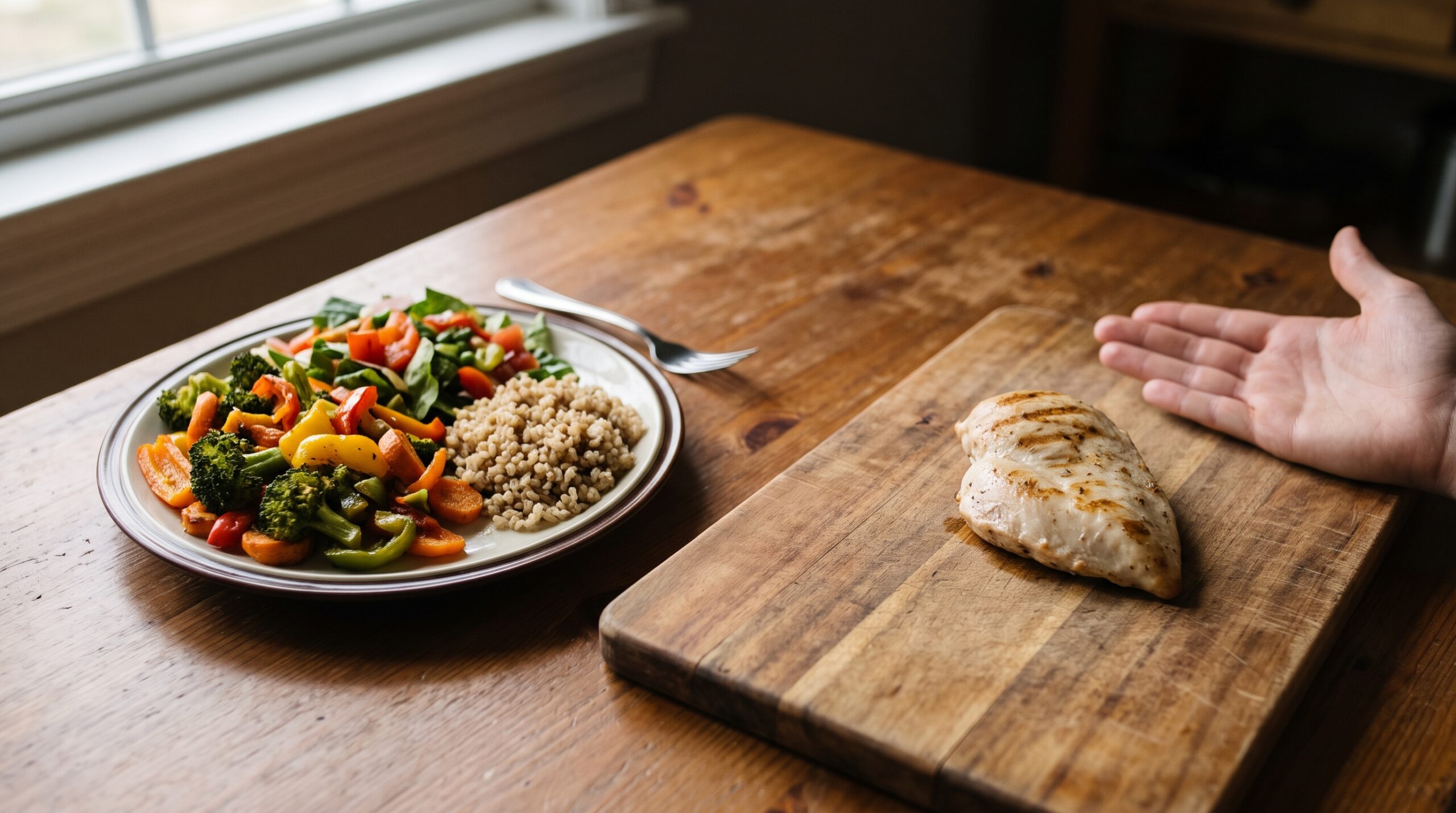
How much fiber do I need to improve insulin sensitivity?
Aim for about 14 grams of fiber per 1,000 calories. That is roughly 25 grams a day for most women and 38 grams for most men, according to the USDA Dietary Guidelines. Most Americans land well below that.
Fiber is the part of plant food your body cannot digest. It slows how fast sugar enters your blood, so the spike is smaller and the insulin demand is lower.
Proof: A 2021 meta-analysis in the Journal of Functional Foods pooled 22 randomized trials with 911 people with type 2 diabetes. A median of just 10 grams of added fiber per day for about 8 weeks lowered A1c, fasting glucose, fasting insulin, and HOMA-IR. Most of those trials used soluble fiber products, and the authors called for longer studies.
Real food fiber, by the numbers:
How to do it without gas and bloating: add a little more each week and drink more water.
Does food order really change my blood sugar?
In small studies, eating vegetables and protein before carbohydrates produced lower blood sugar and lower insulin after the meal. It costs nothing to try, but the studies are small and short.
The evidence:
Researchers think protein and fat trigger a gut hormone called GLP-1 that slows how fast the stomach empties, while fiber slows carb digestion. Think of it as laying a speed bump before the sugar arrives.
The 4-step food order:
- 1Vegetables or salad first
- 2Protein second
- 3Healthy fats and everything else
- 4Starchy carbs and fruit last
You do not need a stopwatch. The studies waited 10 to 15 minutes, but simply eating the carbs last is the practical version.
What does the insulin resistance plate look like?
Build it in this order: half the plate non-starchy vegetables, 30 or more grams of protein, a thumb of healthy fat, and a small portion of high-fiber carbs. That is the plate.
Your 5-part plate:
A note on style. Dr. Bikman's companion book, How Not to Get Sick, leans low-carb and keto-friendly. The food order and fiber research above does not require going low-carb. Pick the version you can keep for years, not the one that wins an argument online.
Multimodal placement: Embed the plate graphic here. This is the image most likely to be shared and saved.
What does a 3-day insulin resistance meal plan look like?
Each day gives you about 110 grams of protein and roughly 25 to 33 grams of fiber across three meals. Numbers are rounded estimates, so treat them as targets, not a lab result. Add a snack of berries, nuts, or beans if you want to land closer to your fiber target, especially if you are a man aiming for about 38 grams.
Eat the vegetables and protein first at every meal.
Day 1
Breakfast: Three-egg scramble with spinach, half a cup of black beans, and half an avocado. About 28 g protein, 12 g fiber. Lunch: Big salad with greens, cucumber, and tomato, topped with 4 ounces grilled chicken and half a cup of chickpeas, olive oil and lemon. About 40 g protein, 9 g fiber. Dinner: 6 ounces baked salmon, roasted broccoli, half a cup of cooked lentils. About 43 g protein, 12 g fiber.
Day 2
Breakfast: 1 cup plain Greek yogurt, 1 cup raspberries, 1 tablespoon chia seeds, a handful of walnuts. About 30 g protein, 13 g fiber. Lunch: Turkey and bean chili (4 ounces turkey, three-quarters cup kidney beans) with a side of cabbage slaw. About 38 g protein, 10 g fiber. Dinner: 6 ounces sirloin steak, sauteed mushrooms and green beans, a small sweet potato. About 44 g protein, 8 g fiber.
Day 3
Breakfast: 1 cup cottage cheese, 1 cup blueberries, 2 tablespoons hemp seeds, 1 tablespoon chia. About 34 g protein, 9 g fiber. Lunch: One can of tuna over greens with half a cup of white beans, cherry tomatoes, cucumber, olive oil and mustard. About 38 g protein, 9 g fiber. Dinner: 6 ounces roasted chicken thigh, roasted Brussels sprouts, half a cup of cooked pearled barley. About 42 g protein, 7 g fiber.
Swap rules: trade any protein for another from the list above, trade any vegetable for another, and keep carbs small and high-fiber.
Optional affiliate placement: add a line here about where you source quality protein, using your approved partner links.
Get your free 3-day plan. Check off three days of simple habits and see how your energy changes. Sign up at HealthyRant.com and the printable checklist lands in your inbox. Type "3-day insulin resistance," and we'll send it over.
What else rebuilds insulin sensitivity besides food?
Three habits multiply the plate: move after meals, build muscle, and protect your sleep. Food sets the signal. Movement and muscle give the sugar somewhere to go.
Proof: A 2022 meta-analysis in Sports Medicine pooled seven studies and found light walking breaks lowered blood sugar by an average of 17 percent compared with sitting, while standing breaks lowered it by about 9.5 percent. Walking even two to five minutes after a meal helped.
Your 3 habit stack:
Start small and build slowly” is the guiding tip for habit formation.
What does this research not prove?
The evidence is real but early. Most food order studies are small pilots that tracked blood sugar for two or three hours, not months. The fiber meta-analysis was mostly in people who already have type 2 diabetes. Protein results are mixed when weight does not change.
Your own response also varies. That is why testing matters. Recheck the five numbers listed earlier with your doctor after 8 to 12 weeks, and consider a continuous glucose monitor to see your personal response.
Who should talk to their doctor first?
Talk to your doctor before changing your diet if you take diabetes medication, have kidney disease, or have digestive conditions. These are the three situations where the changes above can cause trouble.
Educational only. Talk to your doctor or other health practitioner.
7 Questions About Eating for Insulin Resistance, Answered
Can you reverse insulin resistance with diet alone?
Many people improve it a lot with food, movement, sleep, and healthy weight changes. How far it goes depends on your starting point, so track your labs.
Is high protein bad for insulin resistance?
The trials above did not show harm from higher protein, and several showed better insulin sensitivity. If you have kidney disease, ask your doctor first.
Do I need to go low-carb?
Not necessarily. Fiber, protein, and food order all work with carbs on the plate. Dr. Bikman's books lean low-carb, so it is a valid option if you like it.
How long until I see a change?
The trials cited here ran 1 to 8 weeks. Recheck labs with your doctor after 8 to 12 weeks.
Does fruit spike insulin?
Whole fruit comes packed with fiber. A cup of raspberries has about 8 grams. Juice removes most of that fiber, so skip it.
What labs track progress?
Fasting glucose, A1c, fasting insulin, triglycerides, and HDL are a strong starting set. Ask your doctor which are right for you.
Should I really walk after meals?
Yes. Two to five minutes of light walking was enough to lower blood sugar in the 2022 meta-analysis.
Key Takeaways
Sources
Food Order Has a Significant Impact on Postprandial Glucose and Insulin Levels (Diabetes Care, 2015)
The impact of food order on postprandial glycemic excursions in prediabetes
Food order affects blood glucose, Frontiers in Nutrition, 2024
Food order and eating speed, Nutrients, 2023 (NutritionInsight coverage)
High-protein functional foods and insulin resistance. Nutrients, 2017
Randomized trial of high protein and insulin sensitivity in 158 overweight and obese adults
Most Americans are not getting enough fiber, American Society for Nutrition
Educational only. Talk to your doctor or other health practitioner.
This content is for educational and informational purposes only and is not medical advice, diagnosis, or treatment. Always consult a qualified healthcare professional before starting any new diet, exercise program, supplement, or health routine. Results may vary. If you think you have a medical emergency, call your local emergency number.
Read our full Medical Disclaimer.