
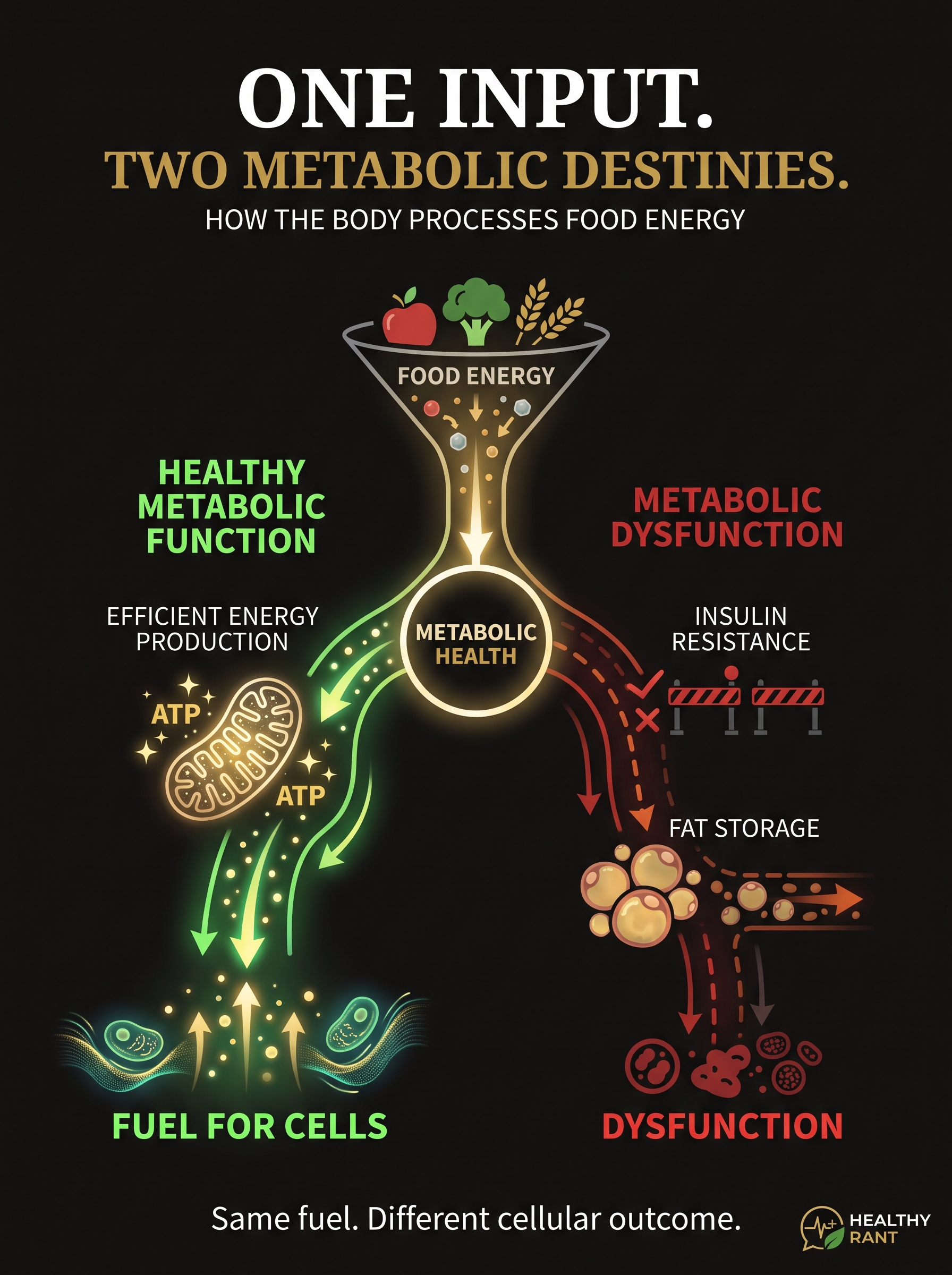
Your metabolism is not your enemy. It's the engine that determines whether your body stores fat or builds muscle, whether you stay hungry two hours after eating or feel satisfied for five, and whether your cells age or repair.
What Is Metabolic Health, Really?
Your metabolism is how your body converts food into energy and uses that energy to function. But metabolic health is more specific: it's your body's ability to process that food efficiently, regulate blood sugar, manage insulin, and use fat for fuel without constant cravings.
Most people think metabolism is just "how fast you burn calories." That's the trap. The real story is metabolic flexibility—your cells' ability to switch between burning carbs and burning fat depending on what your body needs.
When your metabolism is dysfunctional, two things happen:
This is why two people can eat the same calories and get completely different results. One has metabolic flexibility. The other doesn't.
Why Metabolic Health Is Your Foundation
Everything downstream from this pillar depends on it. Your energy levels, your ability to build muscle, your hormones, your brain function—all of it starts with metabolic health.
Here's what happens when your metabolism is broken:
Insulin dysregulation — Your cells become resistant to insulin, meaning they don't respond to the signal to use glucose. Your pancreas works harder and harder to get the same result. Over time, this leads to prediabetes, type 2 diabetes, and metabolic syndrome.
Fat storage, not fat loss — Even when you eat less, your body prioritizes fat storage over using existing fat for fuel. Your mitochondria (the powerhouses of your cells) lose the ability to burn fat efficiently.
Constant hunger — Broken metabolic signaling means your brain doesn't register fullness. You feel hungry even after eating, which leads to overeating and weight gain.
Low energy — If your cells can't efficiently produce ATP (cellular energy), you feel tired no matter how much you sleep.
The good news: metabolic health responds to intervention. Unlike genetics, it's malleable.
Key Components of Metabolic Health
What the research shows you need:
How Metabolic Health Connects to the Other Pillars
Metabolic Health → Longevity Your metabolic rate is one of the strongest predictors of lifespan. Research from Dr. Peter Attia and others shows that insulin sensitivity correlates with disease prevention better than cholesterol alone. Fix your metabolism now, add years to your life.
Metabolic Health → Exercise Physiology You can't build muscle or get stronger if your body can't process nutrients efficiently. Your training works only if your metabolism can deliver fuel to working muscles and clear metabolic waste afterward.
Metabolic Health → Preventative Nutrition Food is information for your metabolism. What you eat either supports metabolic flexibility or destroys it. Nutrition without metabolic awareness is just calorie counting.
Metabolic Health → Neurological Optimization Your brain consumes 20% of your body's energy. A broken metabolism means your brain doesn't get stable fuel, leading to brain fog, poor focus, and mood dysregulation. Fix your metabolism, sharpen your mind.
Get Started: Your First Step
You don't need lab work yet. Start here:
Track your hunger and energy for one week. Don't change anything. Just notice:
These are signals of metabolic flexibility (or lack of it). Metabolic dysfunction shows up as constant hunger, energy crashes, and cravings.
Once you understand your baseline, you can build a plan that actually works.