
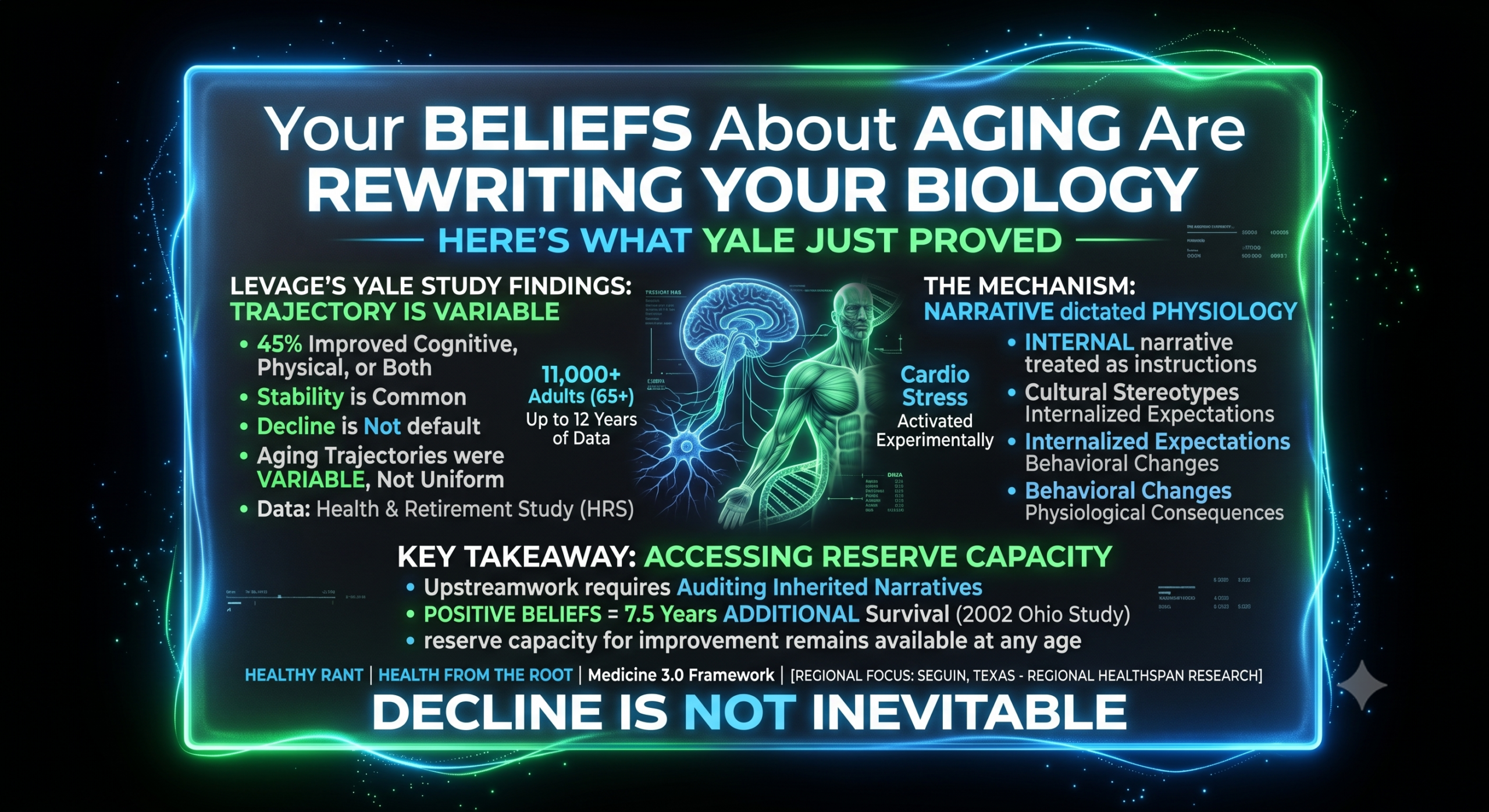
Your Beliefs About Aging Are Rewriting Your Biology. Here's What Yale Just Proved.
What if one of the strongest predictors of how you age has nothing to do with your genes, your diet, or how much you exercise? A recent Yale study analyzing up to 12 years of data on over 11,000 adults found that aging is not a one-way decline curve, and your beliefs about aging are among the most powerful factors shaping which direction you go.
This isn't motivational fluff. It's longitudinal research showing that many older adults improve over time, and the people who do tend to share one thing: they believe aging doesn't have to mean decline.
The Yale Study: What They Actually Found
What did the recent Yale aging study discover about how older adults change over time? Analyzing data from over 11,000 adults tracked for up to 12 years, researchers found that 45% improved in cognitive function, physical function, or both. Aging trajectories were variable, not uniform.
Most people assume aging equals decline. The research says the picture is more complicated than that.
Levy's team from Yale School of Public Health used data from the Health and Retirement Study, tracking adults 65 and older over up to 12 years and measuring changes in cognitive function (memory, thinking speed) and physical function (walking speed, mobility). The results challenged the standard aging narrative:
Core Findings from the Recent Yale Aging Study
- 145% improved in cognitive, physical, or combined function
- 232% improved cognition specifically (memory and thinking)
- 328% improved physical function (walking speed, movement capacity)
- 4More than 50% maintained or improved cognition over the decade
- 5Improvements were clinically meaningful, not marginal changes
- 6All of this in adults already 65 and older
The Mechanism That Changed Everything: Stereotype Embodiment Theory
How does a belief actually change your physiology? Your nervous system treats your internal narrative as instructions, and your body follows.
This is the framework behind Stereotype Embodiment Theory, developed by Levy over decades of research, and it's the mechanism that explains why beliefs about aging aren't just ideas. They appear to function as instructions your biology is executing.
Here's how the pathway works:
You absorb cultural stereotypes about aging throughout your lifetime, beginning in childhood. These messages are rarely explicit. They're woven into media, conversations, how older people are treated in families and institutions, and the language we use about getting old.
Those external messages become internalized expectations. They move from "the culture says" to "I believe."
Once internalized, they trigger behavioral changes. If you believe you're declining, you attempt less. You move less. You engage your brain less. You socialize less. Your expectations shrink your world.
Those behavioral changes create physiological consequences. Less movement means less muscle stimulus. Less cognitive engagement means less neuroplasticity. Less social connection is associated with increased inflammation. Your body isn't choosing decline. Your behaviors are triggering it.
And those physiological changes reinforce the original belief. The prediction seems to prove itself.
That loop, from belief to behavior to biology to reinforced belief, is what makes age stereotypes so consequential.
The Specific Health Outcomes Associated With Age Beliefs
What exactly changes when researchers compare people with positive versus negative aging beliefs? The documented associations span nearly every aging-related health outcome.
Levy's research program, extending back to her 2002 longevity paper and including subsequent experimental and observational work, has built a substantial evidence base:
Health Outcomes Associated With Age Beliefs in Levy's Research
- 1Cardiovascular stress: Negative age stereotypes are associated with measurably higher blood pressure in experimental conditions. Positive stereotypes reduce it.
- 2Memory performance: People with positive age beliefs consistently score better on cognitive testing in longitudinal analyses.
- 3Walking speed: Physical function declines faster in people who hold negative age stereotypes, even after controlling for health variables.
- 4Alzheimer's biomarkers: Negative age beliefs predict higher levels of tau and amyloid (brain markers associated with neurodegeneration).
- 5Recovery from mild cognitive impairment: People with positive age beliefs are more likely to recover from MCI and recover sooner.
- 6Lifespan: In Levy's 2002 Ohio Longitudinal Study, positive age beliefs were associated with approximately 7.5 years of additional survival.
- 7Hearing loss, cardiovascular disease, high blood pressure: Levy's research suggests these are amplified by negative age stereotypes beyond what biology alone would predict.
One important clarification: these are strong predictive associations, many of them surviving rigorous statistical controls, and supported by experimental evidence on mechanisms. As with most longitudinal research in free-living humans, definitive causal claims are difficult. What the body of research establishes is that the associations are robust, the mechanisms are plausible and experimentally demonstrated, and the effect sizes are clinically meaningful.
The Cardiovascular Experiment That Made the Mechanism Concrete
Why does cardiovascular health respond to age beliefs in controlled experiments? Because the nervous system's stress response is directly modulated by the meaning we assign to our situation, and beliefs about aging shape that meaning.
In one of Levy's most striking experiments, researchers exposed older adults (ages 62 to 82) to either positive or negative age stereotypes by flashing words on a screen for fractions of a second. The positive group saw words like "wisdom" and "creative." The negative group saw words like "senile" and "dying."
Subliminal exposure. Fractions of a second. No conscious awareness.
The result: The positive stereotype group showed significant decreases in systolic and diastolic blood pressure. The negative stereotype group showed increased cardiovascular stress markers.
Same people. Same bodies. Different belief states activated subliminally. Different measurable physiology.
This matters because chronic elevated cardiovascular stress is a known contributor to heart disease development. The experiment demonstrated that the pathway from age belief to physiological change doesn't require conscious deliberate thought. It operates below awareness.
The Lifespan Study: Where the 7.5 Years Comes From
How did Levy's earlier research connect age beliefs to actual longevity? The 2002 Ohio Longitudinal Study followed 660 adults over 23 years and used public records to track mortality.
Participants were asked about their attitudes toward aging decades before they died. The researchers then measured whether those early attitudes predicted who lived longer.
The finding: People with more positive self-perceptions of aging in midlife survived approximately 7.5 years longer than those with more negative perceptions. This effect held after controlling for age, sex, socioeconomic status, loneliness, and functional health.
That's a larger survival advantage than several major cardiovascular risk factors. And it was measured before the participants had developed age-related disease.
Why This Connects to the Medicine 2.0 vs. Medicine 3.0 Framework
What's the difference between traditional and preventative medicine's approach to aging? One treats aging as a disease to manage. The other treats it as a trajectory to influence.
Medicine 2.0 assumes decline is the default. The system is built to monitor and treat what goes wrong. The doctor is waiting for the condition to develop. The conversation happens after the damage is done.
Medicine 3.0, the framework built around longevity medicine, says you have substantial agency over your aging trajectory. Your behaviors, beliefs, and biology interact continuously. The intervention window is now, not later.
Levy's research is evidence that supports the Medicine 3.0 model. It demonstrates that something as modifiable as a belief about aging predicts outcomes as significant as lifespan, cognitive function, and cardiovascular health.
The uncomfortable implication: most people are trying to follow preventative protocols while still running a declining-by-default belief system. The supplement, the workout, the dietary change, all of those are working against an upstream assumption that aging means decline.
Addressing beliefs is part of the upstream work.
The Cultural Inheritance Problem
Where do your beliefs about aging actually come from? Not primarily from your personal experience. From the culture you grew up in.
You've been absorbing messages about aging since childhood. Media representations of older adults. Conversations in your family about "getting old." Watching what happened to grandparents. Cultural humor about aging. Pharmaceutical advertising that frames every age-related change as a symptom requiring treatment.
Most of that narrative moves in one direction: decline is expected, normal, and inevitable.
These aren't scientific observations. They're cultural stereotypes that have been encoded into your nervous system, in Levy's framework, through the very process of being raised in an ageist culture.
Common Aging Narratives Running Below Awareness
- 1"Aging means inevitable decline" (prevents challenge and adaptation)
- 2"My memory will get worse as I get older" (creates anxiety that actually impairs memory performance)
- 3"I can't do what I used to do" (prevents physical challenges that would trigger adaptation)
- 4"This is just part of getting old" (removes agency from health decisions)
- 5"I'm past my prime" (shrinks effort, engagement, and possibility)
- 6"Health problems are just aging" (stops investigation of root causes)
These narratives feel true because you see apparent evidence for them. But some of that evidence is being created by the behaviors the narrative is triggering. That's the self-fulfilling loop.
The Reserve Capacity Finding
What did the recent Yale study find about whether older adults actually have room to improve? The researchers described what they called a "reserve capacity for improvement in later life" in people with positive age beliefs.
This is one of the most practically important findings. It suggests that the capacity for cognitive and physical improvement doesn't disappear at 65. It remains available. But whether people access it appears to depend significantly on whether they believe it's there.
From an evolutionary biology standpoint, this makes sense. Your body doesn't have a built-in scheduled decline. Evolution selected for organisms that could adapt to demand at any age. The adaptive mechanisms are present. They respond to the signals you send them through behavior and belief.
The research suggests that positive age beliefs are one pathway through which people activate that reserve capacity and negative age beliefs are one pathway through which people leave it untouched.
How This Connects to Your Health Pillars
How does a belief about aging affect every dimension of preventative health? The downstream effects touch all five pillars.
Longevity: Age beliefs are among the strongest documented predictors of lifespan in Levy's research. This is as upstream as prevention gets.
Metabolic Health: Negative age beliefs activate the stress response chronically, elevating cortisol. Chronic cortisol elevation disrupts insulin sensitivity and promotes visceral fat accumulation. Your metabolism is downstream of your nervous system.
Exercise Physiology: Beliefs about whether your body can adapt determine whether you challenge it. If you believe decline is fixed, you protect yourself from effort. Adaptation requires demand. No demand, no adaptation.
Neurological Optimization: Cognitive engagement, which depends heavily on whether you believe your brain is trainable, is one of the strongest drivers of neuroplasticity. Belief that the brain can improve is part of what allows it to improve.
Preventative Nutrition: Dietary adherence depends partly on whether you believe your body will respond. The belief that your metabolism is broken or age-compromised is associated with lower adherence and less sustained effort.
The Proof Loop: Why Experience Shifts Belief Faster Than Arguments
Why doesn't reading a study about positive aging beliefs immediately change yours? Because your nervous system updates on experience, not on intellectual agreement.
You can accept the facts on a logical level while your operating system remains unchanged. The nervous system needs lived evidence.
This is why the behavioral proof loop matters more than motivational framing. You don't simply decide to believe differently. You do something that demonstrates the old belief is wrong. Your body experiences the result. Your nervous system updates.
Then the updated belief changes behavior. Which produces more evidence. Which strengthens the belief further.
The entry point is action that contradicts the narrative, not argument against the narrative.
The Strong 60 Scorecard as a Belief-Shifting Tool
How do you build a systematic proof loop against aging decline narratives? By tracking the specific metrics that contradict them.
The Strong 60 Scorecard tracks 10 categories specifically because they generate measurable evidence against the most common aging narratives. Each category is designed to show you a trajectory, not a snapshot.
Strong 60 Categories as Decline Narrative Contradictions
- 1Strength: Grip strength, loaded carry capacity (contradicts "I'm getting weaker")
- 2Cardio: Walking speed, VO2 max proxy, endurance (contradicts "I'm getting slower")
- 3Metabolic: Fasting glucose, triglycerides, waist circumference (contradicts "my metabolism is broken")
- 4Recovery: Sleep quality, readiness, HRV (contradicts "I don't recover anymore")
- 5Biomarkers: Inflammatory markers, lipid profile, nutrient status (contradicts "my labs are just getting worse")
- 6Mobility: Range of motion, movement quality, pain levels (contradicts "stiffness is inevitable")
- 7Movement: Training consistency, recreational movement, outdoor activity (contradicts "I can't move like I used to")
- 8Nutrition: Whole food consistency, energy levels, adherence (contradicts "I can't change my habits")
- 9Stress: Perceived stress, sleep quality, HRV trends (contradicts "stress just comes with age")
- 10Community: Social engagement, accountability relationships (contradicts "isolation is normal")
The scorecard isn't just a health tracking tool. Each metric tracked over time is a data point against a declining-by-default belief system. This is the proof loop mechanism.
Note clearly: The Strong 60 Scorecard and the protocols we recommend at Healthy Rant are extensions of the research evidence, practical tools built on findings like Levy's, but they're not part of her peer-reviewed work. The science establishes that beliefs are modifiable and consequential. The tools are how we apply that finding.
Your First Step: The Age Beliefs Audit
What's the single most useful thing you can do right now based on this research? Make your aging beliefs conscious, because you can't work with what you can't see.
For the next 3 days, listen to every sentence you say or think about aging, your capacity, your future, your body.
Listen for:
"I'm too old to..." "My body doesn't respond like it used to..." "That's just part of getting old..." "I can't recover like I used to..." "I've never been able to..."
Write them down without judgment. Don't try to change them yet.
Most of these beliefs are running below awareness. They're operating as background instructions your nervous system is executing without your deliberate input. Making them conscious is the first required move.
We've put together a free Age Beliefs Audit worksheet that walks you through this process with 15 specific prompts across aging, fitness, nutrition, stress, and recovery beliefs. Download it below.
Key Takeaways
Your beliefs about aging are not just opinions. The research suggests they function as instructions your nervous system executes, shaping behavior, physiology, and health outcomes over time.
The recent Yale study analyzing data from over 11,000 adults over up to 12 years found that 45% improved in cognitive or physical function, with positive age beliefs among the strongest predictors of who improved. Trajectories were variable, not fixed.
Becca Levy's earlier longevity research found that positive age beliefs were associated with approximately 7.5 years of additional survival after controlling for traditional health risk factors.
Experimental evidence (the subliminal priming studies) demonstrates the mechanism is real and operates below conscious awareness: brief exposure to negative age stereotypes measurably increases cardiovascular stress.
Stereotype Embodiment Theory provides the mechanism: cultural beliefs become internal expectations, which shape behavior, which shape physiology, which reinforce the original beliefs.
The research establishes strong predictive associations and experimental support for plausible mechanisms. As with most longitudinal work in humans, definitive causal claims are difficult. What's established is that the associations are robust and the effect sizes are clinically meaningful.
Your biggest upstream lever for aging well isn't another protocol. It's auditing the narrative you inherited about what aging means.
Decline is not inevitable.
Take Action Now
Step 1: Download the Age Beliefs Audit worksheet. Spend 3 days surfacing the aging narratives running below your awareness.
Step 2: Join The Independence Standard. Weekly protocols for applying the research to your actual life, including the Strong 60 Scorecard tracking system and a community actively building proof loops against the decline narrative.
Step 3: Come back next week for Post 2: "Stress Is Killing You (But Only If You Believe It Is)." Kelly McGonigal's research on how your beliefs about stress, not stress itself, determine whether it harms you.
Your beliefs shape your trajectory. Let's make sure they're pointing the right direction.
Enter your text here...