
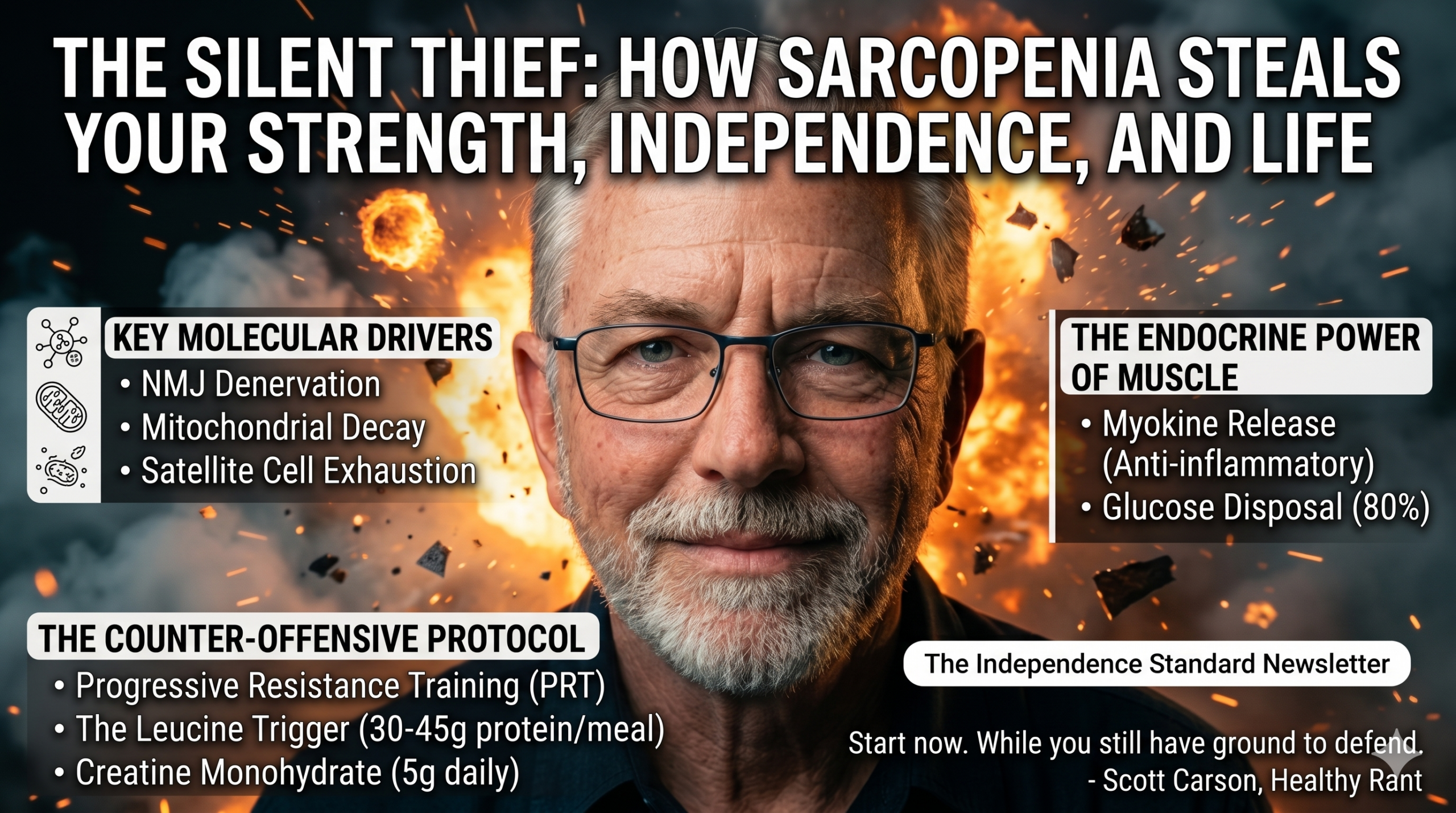
He was 67.
He had worked hard his entire life. Raised a family. Stayed active. Never smoked. Got his annual physical every year without fail.
His doctor told him he was "doing great for his age."
Eighteen months later, he fell in a parking lot. A simple trip. The kind of thing that happens to everyone. But his muscles didn't catch him. His hip shattered. He spent six weeks in a rehabilitation facility. He never fully regained his independent gait.
He didn't fall because he was unlucky.
He fell because he had been silently losing 3 to 8 percent of his muscle mass every decade since his 30s and nobody told him it was happening. Nobody measured it. Nobody intervened.
His doctor was looking for disease. Nobody was looking for the loss that precedes it.
That is the story of sarcopenia. And it may already be your story too.
Here is what medicine rarely tells you:
Muscle is not just the tissue that moves your body. It is the body's largest metabolic organ. It governs your insulin sensitivity, your glucose disposal, your hormonal signaling, your immune function, and your cognitive resilience. When you lose muscle at scale, every system in your body pays the price.
Sarcopenia is the clinical term for that loss. Progressive, age-related decline of skeletal muscle mass, strength, and physical function. It is now recognized by its own ICD-10-CM diagnostic code. It is a disease. Not a "normal part of aging." A disease. One that begins silently in your 30s and accelerates after 60.
The numbers are stark.
According to published research from the NIH, sarcopenia affects 5 to 13 percent of adults aged 60 to 70. By age 80 and beyond, that figure reaches 50 percent. A 2024 meta-analysis of 41,765 participants found that nearly 30 percent of older community-dwelling adults are affected by frailty or sarcopenia. The economic burden in the United States alone was estimated at $18.5 billion annually, and that figure is from the year 2000.
This is not a peripheral health issue. This is a public health crisis hiding in plain sight.
And most people have no idea it is happening to them.
In this post, we are going to break sarcopenia down completely.
You will understand exactly what is happening inside your muscle tissue as you age. Why the standard advice of "stay active and eat well" is not enough to stop it. Why the loss of fast-twitch muscle fibers is the specific biological mechanism that turns a trip into a fall and a fall into a life-altering event.
More importantly: you will leave with a specific, actionable counter-offensive protocol. The mechanical signals, the nutritional thresholds, and the supplementation strategy required to not just slow this process but to actively reverse it.
Decline is not inevitable. But only if you know exactly what you are fighting.
How does sarcopenia silently steal our health and lifespan as we age?
Sarcopenia is the progressive, age-related decline of skeletal muscle mass, strength, and physical function. It begins in your 30s, accelerates dramatically after 60, and operates entirely below the threshold of standard medical detection.
This is not simple muscle atrophy from disuse. Modern molecular biology reveals sarcopenia as an active degenerative disease driven by three simultaneous biological failures: mitochondrial decay, neuromuscular disconnection, and the collapse of muscle stem cell populations.
The most immediately dangerous of these is what happens at the neuromuscular junction (NMJ). This is the critical communication bridge where your nervous system sends electrical signals to your muscle fibers. As you age, motor neurons retract from this junction. The muscle fibers they governed undergo a process called denervation and eventually die. The fibers lost first and fastest are your Type II fast-twitch fibers. These are the fibers responsible for explosive power, speed, and reflexive stabilization. They are the fibers that catch you when you slip.
Research published in Nature Reviews Disease Primers confirms that this disproportionate loss of Type II fibers is the defining structural hallmark of sarcopenia.
Simultaneously, your mitochondria are failing. Studies from Science demonstrate that skeletal muscle aging is characterized by severe mitochondrial dysfunction. As mitochondria lose their capacity to produce ATP efficiently, they generate excessive reactive oxygen species (ROS), creating a state of chronic oxidative stress within the muscle tissue itself.
And underlying all of it: your muscle stem cells, known as satellite cells, lose their ecological niche. Cell research demonstrates that this niche degrades over time, stripping the muscle of its natural ability to repair, regenerate, and adapt to training stress.
The result is what researchers call "inflammaging": a chronic, low-grade systemic inflammation that blocks anabolic pathways, promotes cellular senescence, and keeps the muscle locked in a state of breakdown.
The Molecular Drivers of Sarcopenia
- 1Neuromuscular Junction (NMJ) Denervation. Motor neurons retract from the muscle-nerve bridge, causing rapid atrophy of fast-twitch Type II fibers responsible for explosive power and fall prevention.
- 2Mitochondrial Decay. Reduced ATP production and increased reactive oxygen species generation starve muscle of cellular energy and drive chronic oxidative tissue damage.
- 3Satellite Cell Exhaustion. Muscle stem cells lose their regenerative niche, halting the natural repair and adaptation cycle.
- 4Proteolytic Pathway Hyperactivity. The ubiquitin-proteasome and autophagy-lysosome "molecular scissors" outpace protein synthesis, accelerating net muscle breakdown.
- 5Chronic Inflammaging. Systemic low-grade inflammation blocks anabolic signaling and locks muscle tissue in a catabolic state.
The Evidence
The rate of loss is not hypothetical. It is measurable.
Published research consistently documents that muscle mass declines 3 to 8 percent per decade beginning in your 30s. The rate accelerates after 60. After 70, it can reach 15 percent per decade. In severe cases, individuals in their 80s have lost up to 50 percent of peak muscle mass. A study tracking total muscle size across the adult lifespan found a reduction of 40 percent from age 20 to age 80, with approximately 39 percent fewer muscle fibers in the same timeframe.
At the functional level, a 2024 ARIC cohort study found that among adults aged 65 to 89, sarcopenia prevalence rose from 5 percent at age 65 to 36 percent by age 85 to 89. That is not a gradual slide. That is a cliff.
Sarcopenic individuals face 60 percent higher odds of falling compared to age-matched counterparts without the condition. Falls remain the leading cause of injury-related death in adults over 65.
This is Medicine 2.0 at its most dangerous: a system optimized to detect disease after it has already taken hold, blind to the slow structural erosion that makes catastrophic events possible.
Medicine 3.0 measures the right things before the fall happens.
How do I reverse muscle loss if sarcopenia is already in progress?
Reversing active sarcopenia requires a structured biological and mechanical counter-offensive targeting the specific physiological failures that drive muscle loss: anabolic resistance, protein signaling deficits, and mitochondrial dysfunction.
If you are over 50, the prevention-only window has narrowed significantly. You are not in a maintenance scenario. You are in a rebuilding scenario. And rebuilding a sarcopenic muscle requires a fundamentally different approach than building muscle in a 25-year-old.
The defining physiological challenge is anabolic resistance. Sarcopenic muscles have lost sensitivity to the normal anabolic signals. A 20-gram protein bolus that would effectively stimulate muscle protein synthesis (MPS) in a young adult will not cross the threshold in aging muscle. The signal is the same. The receiver is broken.
To overcome anabolic resistance, you need two things simultaneously: a mechanical signal strong enough to force recruitment of dormant Type II fibers, and a nutritional bolus large enough to trigger the leucine-mediated mTORC1 response.
The mechanical signal comes from heavy, progressive resistance training. Loading the muscle at 70 to 80 percent of your one-rep maximum activates mechanoreceptors on the muscle membrane. This mechanical tension triggers the mTORC1 pathway, the master switch of muscle protein synthesis. Nothing else does this at the same scale.
The leucine trigger is the nutritional threshold. Research published in Cell Metabolism confirms that older adults require a higher concentration of the essential amino acid leucine to initiate MPS. This means a target of 30 to 45 grams of high-quality, leucine-rich protein per meal, not per day. Per meal. Sources: whey protein, beef, eggs, or a high-quality essential amino acid formula.
Together, these two signals override anabolic resistance and force the body to rebuild.
The Sarcopenia Reversal Protocol
- 1Progressive Resistance Training (PRT). Train at 70 to 80 percent of one-rep maximum (RPE 7 to 8), at minimum twice per week, targeting compound movements that recruit the largest muscle groups and highest proportion of Type II fibers.
- 2The Leucine Trigger. Consume 30 to 45 grams of high-quality, leucine-rich protein per meal. Target sources: whey concentrate, lean beef, eggs, or pharmaceutical-grade essential amino acids.
- 3Creatine Monohydrate. Supplement with 5 grams daily. Creatine optimizes cellular hydration and ATP recycling within aging mitochondria, directly addressing one of the primary molecular drivers of sarcopenia.
- 4Anti-Inflammatory Nutrition. Eliminate refined seed oils and added sugars to suppress the chronic inflammaging that maintains the catabolic environment within muscle tissue.
- 5Hormonal Optimization. Address declining testosterone, growth hormone, or estrogen (via transdermal HRT where clinically appropriate) to restore the systemic anabolic environment that heavy training requires.
- 6Structural Biomechanics. Apply Dr. Stuart McGill's neutral spine principles to every compound movement. The goal is maximum loading on the muscle with minimum compressive force on the spine and joints.
How does muscle preservation connect to long-term health and longevity?
Skeletal muscle is the body's primary metabolic organ. Preserving it is not a cosmetic goal. It is the single most powerful systemic defense against insulin resistance, metabolic disease, cognitive decline, and physical dependency.
This is the piece that most people miss. They think of muscle as a tool for movement. It is far more than that.
Contracting muscle fibers release myokines. These are hormone-like proteins including Irisin and IL-15 that travel through the bloodstream and exert anti-inflammatory, neuroprotective, and immune-regulating effects throughout the body. When you lift weights, you are not just building muscle. You are dosing your brain and immune system with a biochemical signal of health.
Muscle is also your body's primary glucose disposal site. Skeletal muscle clears up to 80 percent of post-meal blood glucose under normal insulin signaling. When you lose muscle, you lose the cellular real estate required to perform that function. Insulin resistance follows. Ectopic fat accumulates within the muscle fibers themselves. This condition, called myosteatosis, further impairs muscle function and accelerates the sarcopenic spiral.
This is why Dr. Benjamin Bikman's work on insulin signaling is foundational to the Healthy Rant framework. Maintaining muscle mass is not separate from metabolic health. It is the same problem.
And then there is sleep. Muscle repair does not happen in the gym. It happens in bed. As Dr. Matthew Walker has documented extensively, deep slow-wave sleep is the primary window for growth hormone secretion. Growth hormone is the biological signal that repairs the cellular micro-damage created during resistance training. Without sufficient Stage 3 sleep, the anabolic stimulus from heavy training goes largely unanswered.
Your supplement stack matters here too. The "Calcium Traffic Control" synergy we discuss across Healthy Rant content (Vitamin D3, K2 MK-7, and Magnesium) applies directly to muscle function. Magnesium is the essential cofactor required to activate Vitamin D3 at the enzymatic level. Without adequate magnesium, Vitamin D3 cannot fully perform its role in muscle contraction signaling and protein synthesis.
The Endocrine Power of Skeletal Muscle
- 1Myokine Release. Contracting muscle secretes anti-inflammatory myokines (Irisin, IL-15) that protect brain health, reduce systemic inflammation, and support immune resilience.
- 2Glucose Disposal. Skeletal muscle clears up to 80 percent of post-meal blood glucose, protecting metabolic pathways and insulin sensitivity.
- 3Basal Metabolic Rate. Muscle tissue is metabolically active at rest, sustaining a higher resting caloric burn than adipose tissue and protecting against age-related weight gain.
- 4Myosteatosis Prevention. Maintaining active muscle prevents harmful intramuscular fat infiltration that further impairs contractile function and metabolic signaling.
- 5Myokine-Brain Axis. BDNF and Irisin released during resistance exercise cross the blood-brain barrier and support neuroplasticity, cognitive function, and mood regulation.
The Payoff
Here is the summary that matters.
The 67-year-old man from the beginning of this post did not fall because he was old. He fell because the system designed to protect him was measuring the wrong things. His cholesterol. His blood pressure. His resting heart rate. Nobody measured his grip strength. Nobody ordered a DEXA scan to assess muscle mass. Nobody told him that the 3 to 8 percent per decade he was losing was quietly removing the biological architecture that keeps a person upright when the ground moves underneath them.
You have that information now.
Sarcopenia is not fate. It is a measurable, reversible, preventable disease. The tools to fight it are not exotic. They are a barbell, a protein target, five grams of creatine, and eight hours of sleep.
The work is simple. Demanding, but simple.
And it has to start before you need it. Because once the architecture is gone, rebuilding it is a long war. Starting now, while you still have ground to defend, is the decisive strategic advantage.
This is what Medicine 3.0 looks like. Not waiting for the fall. Measuring, loading, feeding, and sleeping your way to a body that does not fall in the first place.
Key Takeaways
Your Next Step
This is exactly the kind of root-cause framework that The Independence Standard delivers every Sunday morning.
Not symptom management. Not generic wellness advice. The specific mechanisms, the verified research, and the actionable protocols that protect your physical and metabolic independence in the second half of your life.
Free. Every Sunday.
Subscribe at HealthyRant.com/independence-standard.html
Decline is not inevitable.
References
- 1Cruz-Jentoft AJ, et al. Sarcopenia: revised European consensus on definition and diagnosis. Nature Reviews Disease Primers (2024). ESCEO/Nature
- 2Melov S, et al. Resistance exercise reverses aging in human skeletal muscle. PLOS ONE / PMC (2007). PMC1866181
- 3Sousa-Victor P, García-Prat L, Muñoz-Cánoves P. Control of satellite cell function in muscle regeneration and its disruption in ageing. Nature Reviews Molecular Cell Biology (2022) 23(3):204-226. DOI: 10.1038/s41580-021-00421-2 (PMID: 34663964). pubmed.ncbi.nlm.nih.gov +1
- 4Tseng TH, et al. Epidemiology of sarcopenia: A narrative review. Osteoporosis and Sarcopenia (2025). PMC12288926 pmc.ncbi.nlm.nih.gov
- 5ARIC Cohort Study. Sarcopenia incidence from age 65 to 90+, 2011 to 2023. PMC (2024). PMC12762279
- 6GlobalRPH. Hidden Crisis: Why Sarcopenia Treatment Matters. (2025). GlobalRPH
- 7Breen L, Phillips SM. Skeletal muscle protein metabolism in the elderly. PMC / Cell Metabolism context.
- 8NIH StatPearls. Sarcopenia. NBK560813